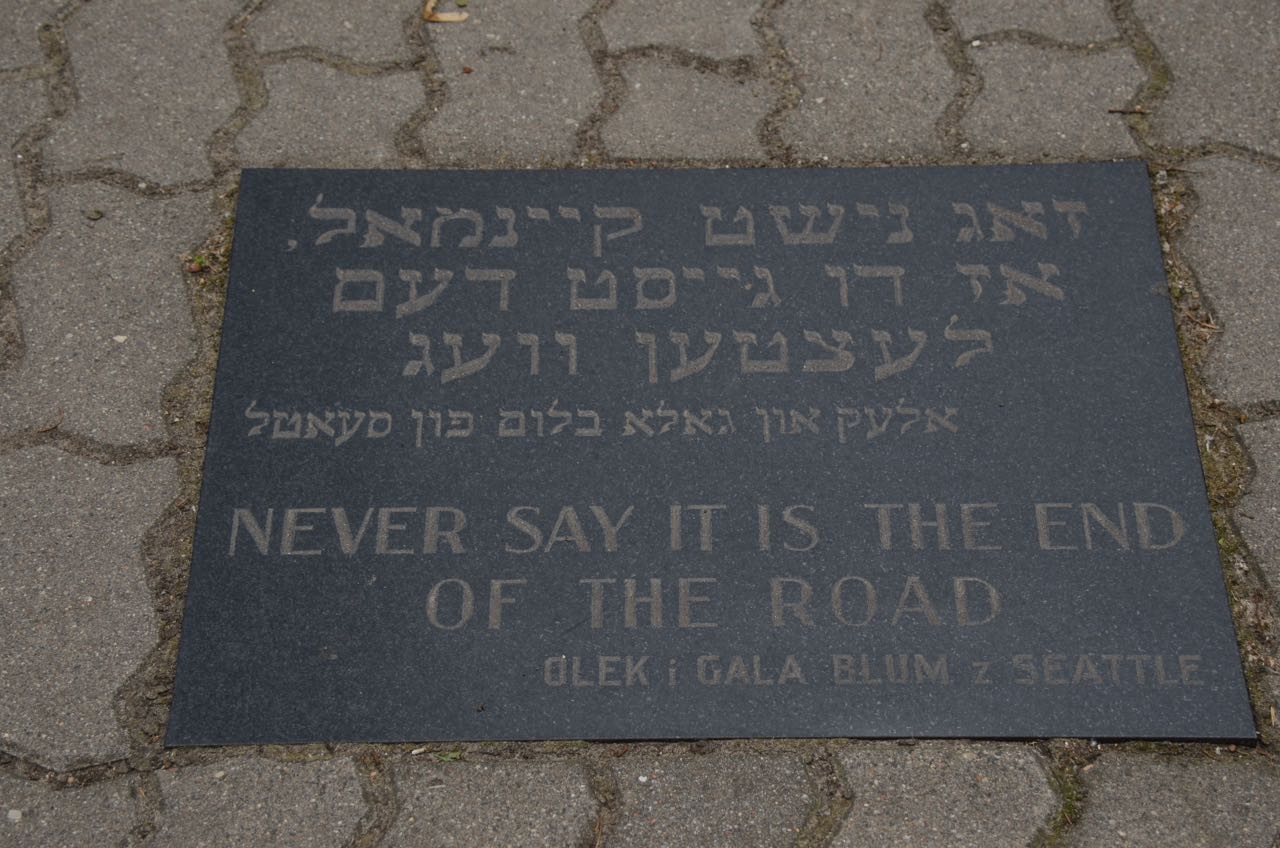
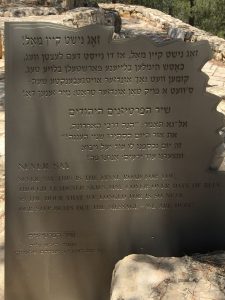
In the lead up to the UN Holocaust Remembrance Day on 27 January, I would like to share several quite different recordings of The Partisan Song, Zog Nit Keynmol.
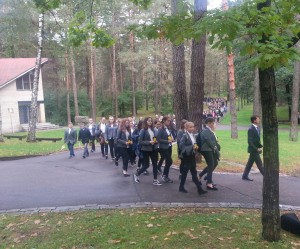
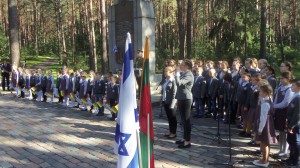
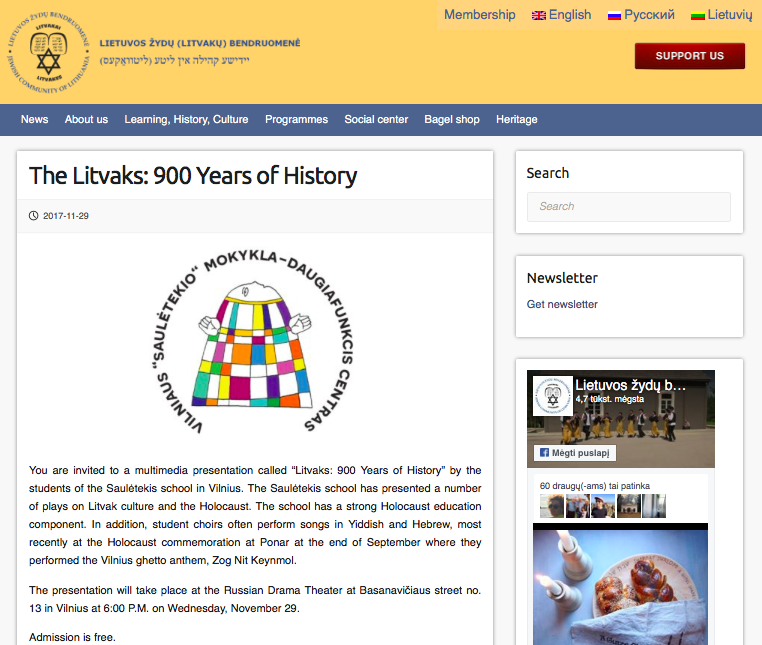
The Saulėtekis School has presented a number of plays on Litvak culture and the Holocaust. The school has a strong Holocaust education component. In addition, student choirs often perform songs in Yiddish and Hebrew, most recently at the Holocaust commemoration at Ponar at the end of September where they performed the Vilnius ghetto anthem, Zog Nit Keynmol.
This was recorded at the school
Tolerance Education Centre – Vilnius “Saulėtekis” Secondary School
Tolerancijos ugdymo centras – Vilniaus “Saulėtekio” vidurinė mokykla
As the 23rd of September commemorates the victims of the Lithuanian Genocide victims, Lithuanian general education schools, Tolerance training centres and all educational institutions are invited to participate in the “Memory path” civic initiative. The initiative seeks to visit the mass graves of the Jews, walking through the path to which innocent people were driven to death…….
Please encourage your students to recite or sing the Partisan Song on the UN Holocaust Remembrance Day on or around 27 January 2018.
Don’t Give Up Hope
Don’t Give Up Hope
Activities for your school, choir or community group for Holocaust Memorial Day – 27 January 2018 A short video explaining the project The Power of Words: learn about the meaning, context and sign…
The Chief Rabbinate of Israel chose to observe the Tenth of Tevet as a “general kaddish day” (yom hakaddish ha’klalli) to allow the relatives of victims of the Holocaust, and whose yahrtzeits (anniversaries of their deaths) is unknown, to observe the traditional yahrtzeit practices for the deceased, including lighting a memorial candle, learning mishnayot and reciting the kaddish. According to the policy of the Chief Rabbinate in Israel, the memorial prayer is also recited in synagogues, after the reading of the Torah at the morning services.[11][12] To some religious Jews, this day is preferable as a remembrance day to Yom HaShoah, since the latter occurs in the month of Nisan, in which mourning is traditionally prohibited.
The HET – Holocaust Education Trust in the UK has included The Partisan Song and the link to my project “Don’t Give Up Hope” in its Readings for Holocaust Memorial Day (HMD) 2018.
“Don’t Give Up Hope is an inspiring project which encourages students around the world to learn and sing Glik’s anthem” says HET’s Martin Winstone.
Martin Winstone | Education Officer
Holocaust Educational Trust
With Martin Winstone
Holocaust Educational Trust – Holocaust Memorial Day 2018: Guidelines and Suggested Readings – download here:
The song is on page 12 and the notes for it on pages 24-25.
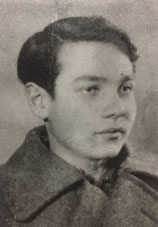
Hirsh Glik 1922 – 1944
Don’t Give Up Hope
Don’t Give Up Hope
Activities for your school, choir or community group for Holocaust Memorial Day – 27 January 2018. A short video explaining the project The Power of Words: learn about the meaning, context and sign…
The Holocaust Educational Trust (HET) is a British charity, based in London, whose aim is to “educate young people of every background about the Holocaust and the important lessons to be learned for today.”[1] It was founded by the Labour MP Greville Janner and the former Labour Home Secretary Merlyn Rees in 1988. One of the Trust’s main achievements was ensuring that the Holocaust formed part of the National Curriculum for history, as it continues to do so.
The most public form of Holocaust education is the annual commemoration of Holocaust Memorial Day (HMD). The day is marked on 27th January each year – the anniversary of the liberation of Auschwitz – and was first held in 2001. Britain was one of the first countries in the world to hold such an event.
With Mickey ShakedRabbi Shalom White lighting the first candle
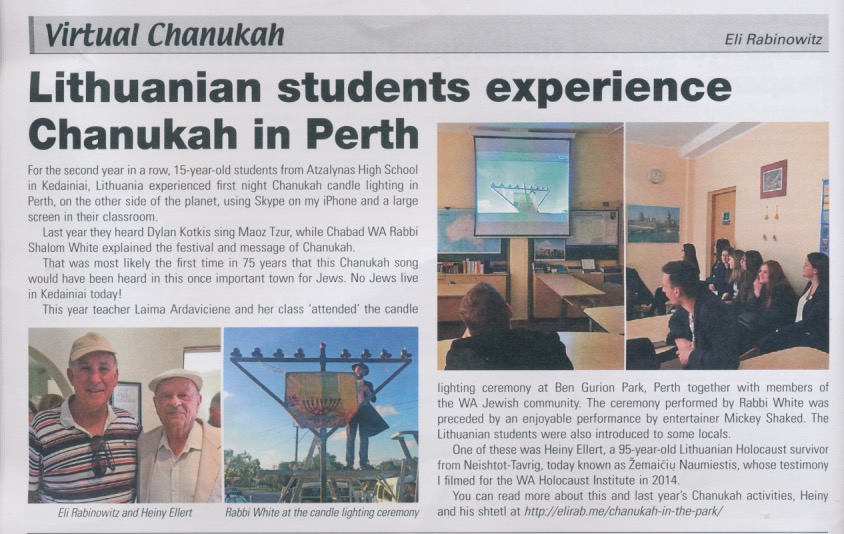
The lighting of the first candle was watched by students at the Atzalynas High School in Kedainiai, Lithuania. I used skype and my iPhone to stream this back live to Laima Ardaviciene and her class. This is the second year in a row we have engaged Laima and her class on Chanukah.
Viewing it all from the classroom in Kedainiai, Lithuania
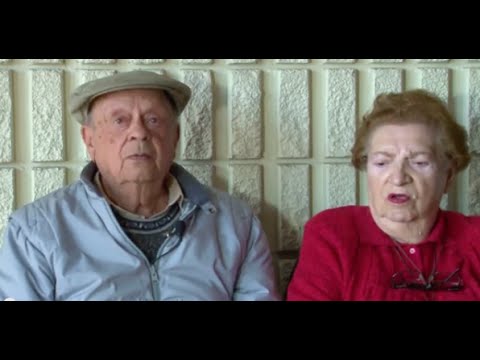
I introduced my friend Heiny Ellert to the class. Heiny, 95, is a Holocaust survivor from Neishtot-Tavrig, today Žemaičių Naumiestis, in Lithuania.
With Heiny Ellert earlier this year
See Heiny Ellert’s Testimony
Heiny Ellert’s Testimony
Heiny Ellert, a Lithuanian Holocaust survivor, tells his story to Eli Rabinowitz. Accompanying him is his wife Toby, also from Lithuania, but who escaped to …
Žemaičių Naumiestis Town in Lithuania Žemaičių Naumiestis is a town in Klaipėda county, Šilutė district municipality. It is located in western Lithuania between Klaipėda and Kaliningrad Oblast. The…
The miracle of Chanukah and the miracle of survival for Heinry Ellert!
This is a second year in a row that:
Maoz Tzur Sung in Perth Heard in Keidan
Maoz Tzur Sung in Perth Heard in Keidan
Just think of this – when was the last time Maoz Tzur was heard in Keidan, Lithuania, sung by a Jewish kid? Maybe 75 years ago! When Laima Ardaviciene, the English teacher at Atzalyno Gymnazi…
Marc Latilla and I visited the SABC earlier this year. We were given a tour by Florence Moshatana, the music archivist.
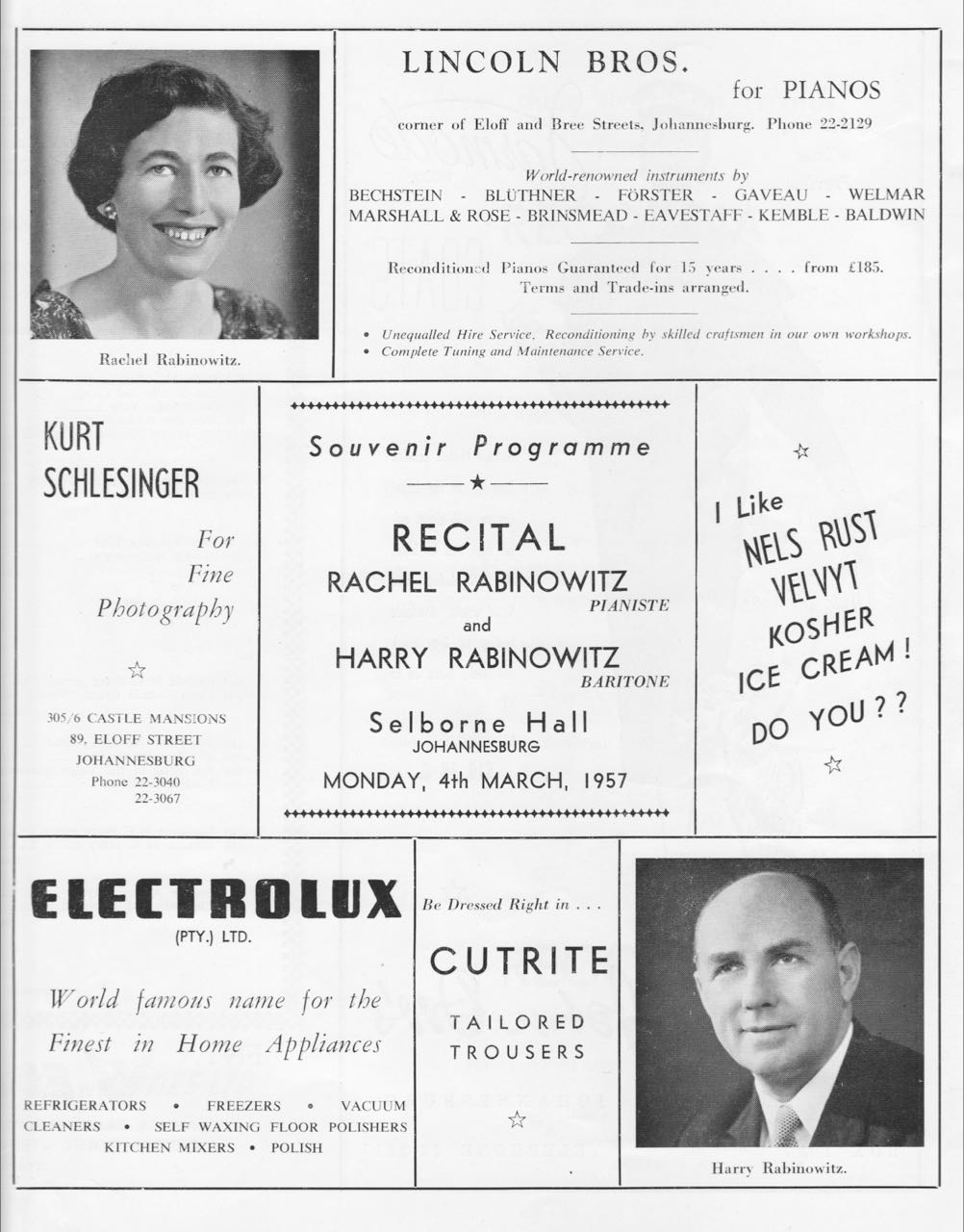
I was looking for recordings of my dad, Harry Rabinowitz, a cantor and singer, and his sister Rachel Rabinowitz, a concert pianist. Both were both featured on the radio and concerts on the SABC over many years.
We were not successful in finding any recordings of Harry or Rachel. The closest I came to Harry was Harry Rabinowitz, the conductor and arranger who passed away in the UK in 2016 at the age of 100.
Harry Rabinowitz v Harry Rabinowitz
Harry Rabinowitz – Wikipedia
Harry Rabinowitz MBE (26 March 1916 – 22 June 2016) was a British conductor and composer of film and television music. Born in Johannesburg, South Africa, he was the son of Israel and Eva Rabinowitz. He was educated at the University of the Witwatersrand and at London’s Guildhall School of Music and Drama.
It was a most interesting tour and my thanks goes out to Florence for showing Marc and me around. Here are some of the photos and information from the visit.
South African Broadcasting Corporation – Wikipedia
South African Broadcasting Corporation – Wikipedia
The South African Broadcasting Corporation (SABC) is the state broadcaster in South Africa, and provides 19 radio stations (AM/FM) as well as 5 television broadcasts to the general public.[2]
RADIO BROADCAST FACILITIES exists primarily to provide the technology infrastructure on which radio programmes are created – from studio broadcast/recording and outside broadcasts all the way through Radio Main Control (RMC) to broadcasting via Sentech.
Syddie, Syddie… Syd Nomis se onderskepdrie – Gerhard Viviers
Syddie, Syddie… Syd Nomis se onderskepdrie – Gerhard Viviers
Syd Nomis onderskep ‘n aangee van Brian Lochore en hardloop deur vir die finale punte in die 1e toets op 25 Julie1970 teen die All Blacks. Die Springbokke he…
Jan Ellis Try – Gerhard Viviers at his best!
Charles Fortune – Wikipedia
Charles Fortune – Wikipedia
Charles Arthur Frederick Fortune (1906 – 22 November 1994) was a South African sport broadcaster and writer, especially noted for his cricket commentaries on radio.
Not part of the SABC, but after closing became Radio 5 in South Africa.
It relaunched as LM Radio in 2010.
LM Radio – Wikipedia
LM Radio is a radio station based in Maputo, Mozambique. Historically it was a shortwave station broadcasting to South Africa and Rhodesia from Lourenço Marques, the colonial era name of Maputo, hence the name “Lourenço Marques Radio” from 1936 to 1975 when it was shut down by the government of the then newly independent country.[1] In 2010, following political reforms and economic development in Mozambique the station was relaunched with the brand “Lifetime Music Radio”.
A ceremony was held on Wednesday to thank those in Kedainiai, Lithuania who organised the recent cleaning of the Jewish cemetery and the matsevot.
Tzvi Friedl, Natan Katzel, Jill Rabinowitz and I joined those at the meeting at the Atzalynas School in Kedainiai just after 8pm Perth time. We joined online from CHABAD Perth, Australia. We thanked those involved in undertaking this huge mitzvah. There are no Jews living in Kedainiai today.
Here is the report from teacher Laima Ardaviciene in Kedainiai – translated from the Lithuanian below:
Valentinas Tamulis, governor of the town of Kėdainiai and Rimantas Žirgulis, director of the Kedainiai Regional Museum, visited Kėdainiai Atzalynas gymnasium. During the meeting the members of the gymnasium community thanked them for their cooperation in carrying out project TILTAI-BRIDGES-בריקן activities related to the Jewish community in Kedainiai. The students shared a recent presentation about the old Kedainiai Jewish Cemetery. Eli Rabinowitz (Australia), rooted in Kedainiai, and Rabbi Natan Katzel joined the meeting virtually and thanked the headman of Kėdainiai for his contribution to the old Kedainiai Jewish cemetery in honor of the Kedainiai Jewish people, Jewish music was played by Tzvi Friedl. Further cooperation activities were discussed during the meeting. The guests were presented with the Kedainiai drawings.
Atžalyno gimnazijoje lankėsi Kėdainių miesto seniūnas Valentinas Tamulis ir Kėdainių krašto muziejaus direktorius Rimantas Žirgulis. Susitikimo metu gimnazijos bendruomenės nariai padėkojo už bendradarbiavimą vykdant projektą TILTAI-BRIDGES-בריקן apie Kėdainiuose buvusią žydų bendruomenę. Gimnazistai pasidalino pastaruoju metu sukurtu pristatymu apie senąsias Kėdainių žydų kapines. Susitikimo metu prisijungė Eli Rabinowitz (Australija), kuris kėdainiečių žydų vardu padėkojo miesto seniūnui už jo indėlį tvarkant senąsias Kėdainių žydų kapines, padėkos žodį tarė ir rabinas Natan Katzel, o muzikiniu kūriniu pasidalino Tzvi Friedl. Susitikimo metu buvo aptarta tolimesnė bendradarbiavimo veikla. Svečiams buvo padovanoti gimnazijos mokinių piešti Kėdainių miestą vaizduojantys piešiniai.
We made three videos:
Participants in Kedainiai:
Valentinas Tamulis, the headman of Kėdainiai
Rimantas Žirgulis, the director of the Kėdainiai Regional History Museum Gintaras Petrulis, the director of Kėdainiai Atžalynas gymnasium Rasa Cicėnienė, the assistant of Kėdainiai Atžalynas gymnasium Lina Blinstrubienė, the assistant of Kėdainiai Atžalynas gymnasium Giedrius Galvanauskas, a student Aistė Vosilytė, a student Šarūnė Makaraitytė, a student
More about the project – Building Bridges In Kedainiai
Building Bridges In Kedainiai
Kedainiai Atžalynas gymnasium students continue the Project: TILTAI-BRIDGES-בריקן . We thank Valentinas Tamulis, the mayor of Kedainiai, and Rimantas Žirgulis for organising cleaning activities in the old Jewish cemetery. Not a single tombstone is covered by a growing tree or a bush now. All the matsevot remind us about the Jewish community that lived in Keidan. We are presenting the recent view of the Old Jewish Cemetery of Keidan.
It began when I started searching “Rachel Rabinowitz” on Google.
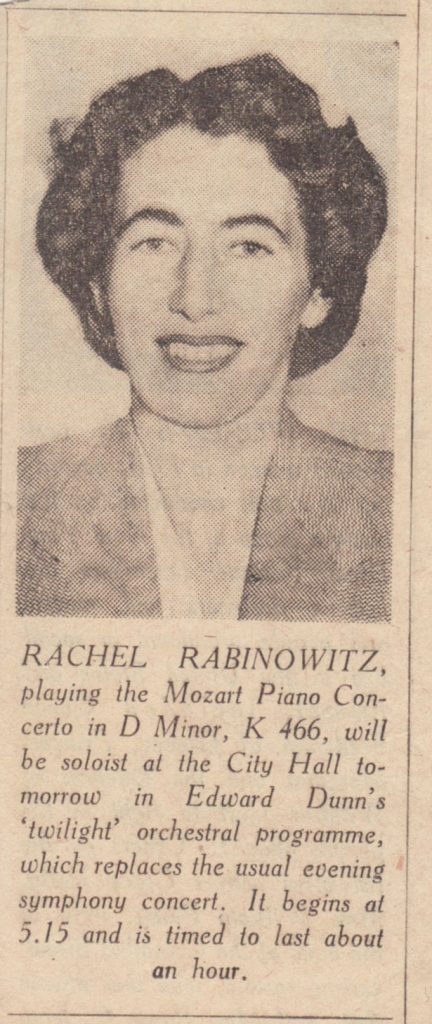
My aunt Rachel Rabinowitz had been a concert pianist in South Africa from the 1950s onwards.
I found this on YouTube:
The comments read:
Published on 24 Jan 2014
‘Three Inventions’ by composer Stefans Grové (pictured above), in a performance by pianist Rachel Rabinowitz. The work has three sections: Tokkate; Pastorale; Fuga. Other works by Stefans Grové have been recorded and are available for purchase at the below links:
I had never come across any vinyl recordings of Rachel’s playing, let alone anything on the web!
I wrote to noochinator who had posted this recording on YouTube.
This is what he said:
I got the recording from a South African LP issued in the 1960s. I don’t own the LP, so I don’t have any more information on it. I have no other recordings of the pianist. You could check at the IPAM, it’s a piano archives at the U. of Maryland.
Thanks to Donald Manildi, curator of IPAM and Maxwell Brown, Project Manager.
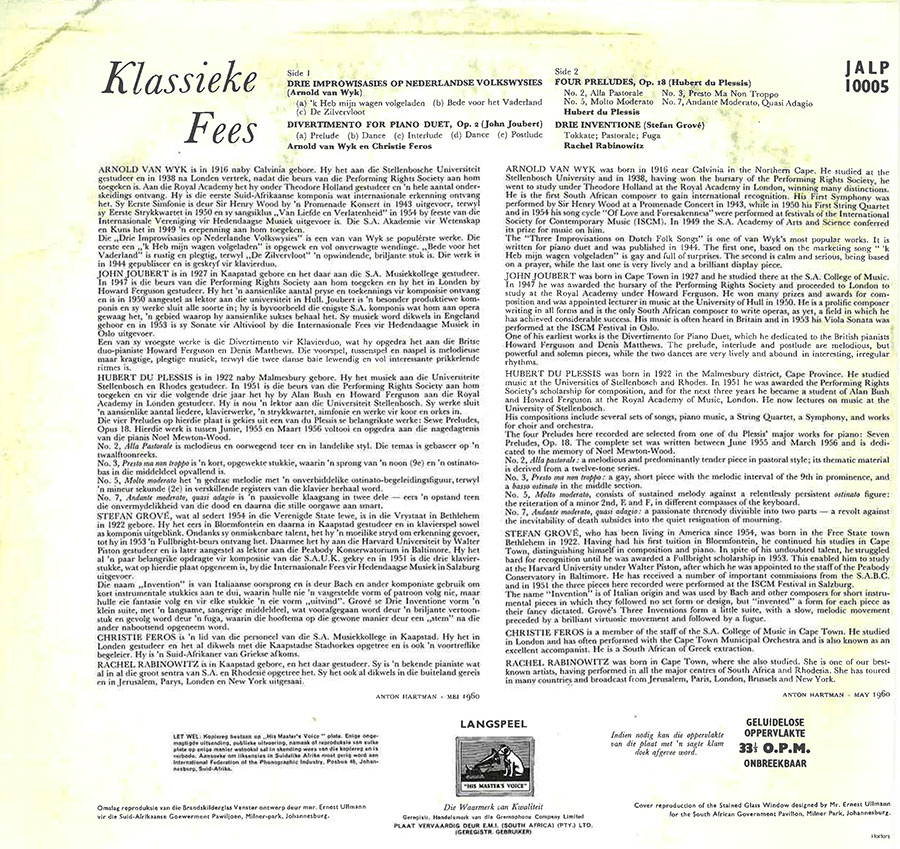
Here is the album cover:
I then asked the classical music reviewer for the West Australian Newspaper, Neville Cohn, an old friend of the family, if he would review the recording for me.
Review by Neville Cohn
Rachel Rabinowitz was at the forefront of those musicians who worked tirelessly to bring music by South African composers to a wide audience both in South Africa and abroad. In those mid-20th century days, there was too often an indifference to new music written by compatriots and it says a very great deal for Rachel and her fellow musicians in this arts arena. This recording of three pieces by Stefans Grove is a model of its kind, thoroughly worthwhile music that could so easily have slipped into oblivion without the pioneering attitude of these artists. In these pieces, we can hear the quality of Rachel’s artistry: impeccable memory, wondrous clarity of presentation and a faultless sense of style.
During my years as, firstly, official accompanist to the SABC and, later, music producer, I was present at just about every recording session by Rachel of programs intended for later broadcast. I noticed then a quality which placed her in a unique category. She would invariably play her recitals entirely from memory. I recall an occasion when she’d been contracted to record a particularly complex and demanding score. But although I suggested it might be less taxing to use the score during the recording session, she insisted, as ever, on committing the work to memory – and performed it faultlessly.
Rachel and my teacher Anne Sher (who was also my aunt) had been fellow students at the College of Music. They would occasionally play piano duets which, as a child, I found a delightful entertainment.
Rachel’s brother Leib and his family, lived across the road from us. Very occasionally, Leib would play the violin for us. I also recall vividly meeting, and listening for the first time to, Leib’s brother Harry. On this particular occasion, Leib had set up a tape recorder to record Harry’s singing. In those days, this was a VERY rare experience – and I listened in awe not only to Harry’s fine voice but the recording of it when played back. I would have had no idea then of how much recording of music would figure in my life during innumerable pre-recorded performances at the SABC studios in Sea Point years later. I’m also old enough to recall playing in a ‘live’ broadcast – in the Young South Africa series (I was 12 years old at the time) – in the original SABC premises squashed between the Del Monico restaurant and the old Royal cinema.
Neville Cohn
Some additional notes from Neville Cohn:
I could write a book about your family as neighbours.
Your uncle Leib had a movie projector and a number of movies from the silent era. We would watch them again and again and again – never got tired of them. We used to invent what we thought they were saying amid gales of laughter. Such delightful, innocent fun – now a vanished world.
Leib lived across the road from us – and I recall a session there with your Dad singing into a very early tape machine which was followed by you singing Tzena Tzena! very loudly. How’s that for a recollection? This might have been in the early 1950s,.
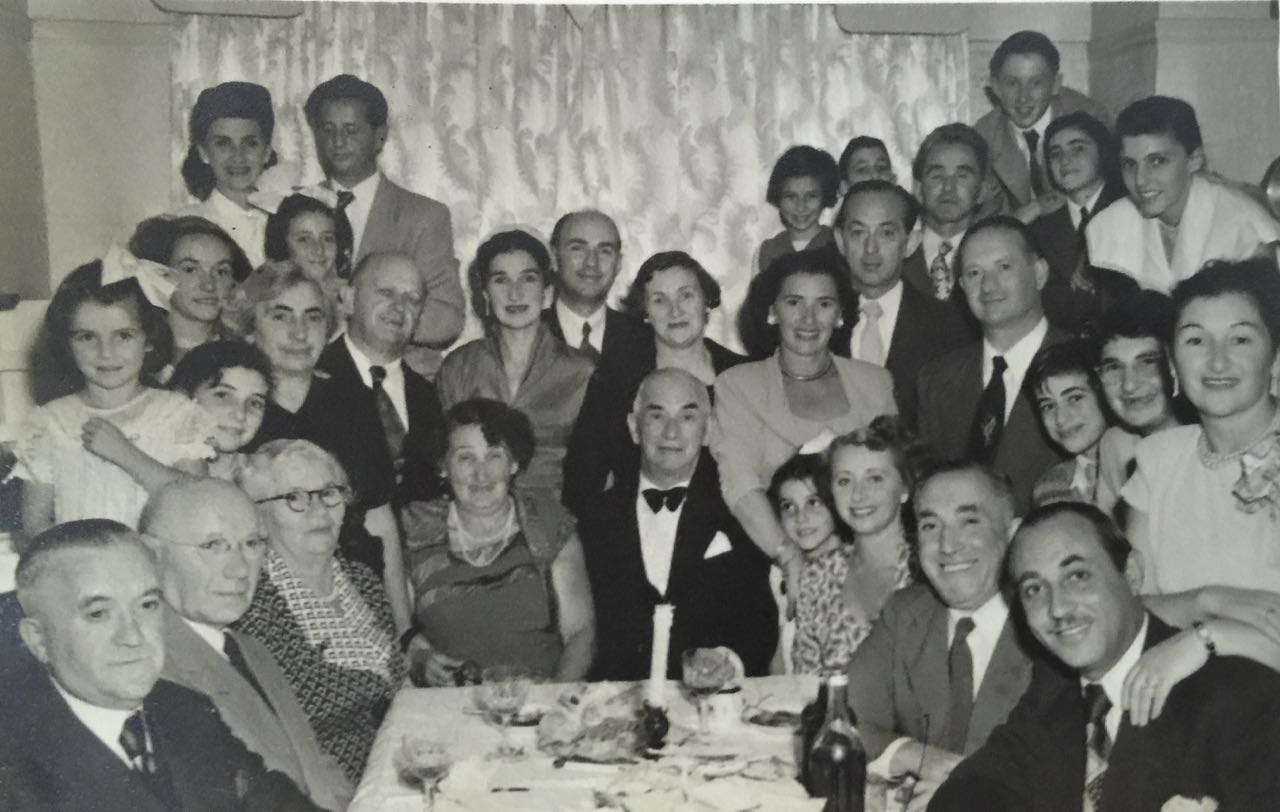
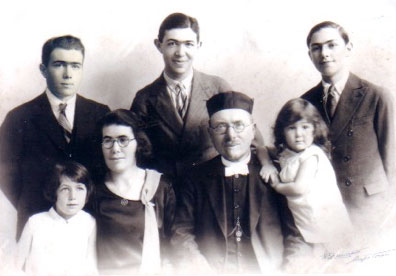
The Rabinowitzs were a musical family:
My zaida was a chazan, as were two of his three sons, Leib and Harry, my dad.
Isaac was a medical doctor.
The sisters Rachel and Sarah were both pianists – Rachel a concert pianist and Sarah a music and piano teacher.
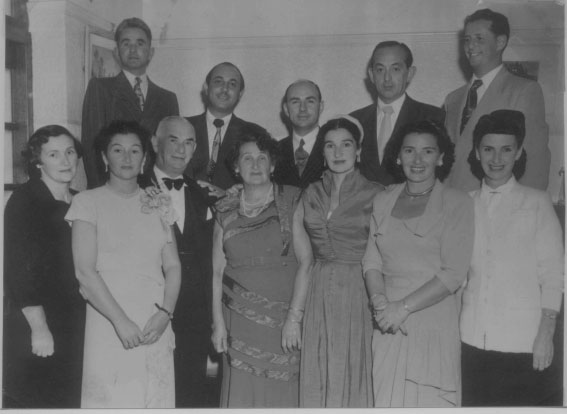
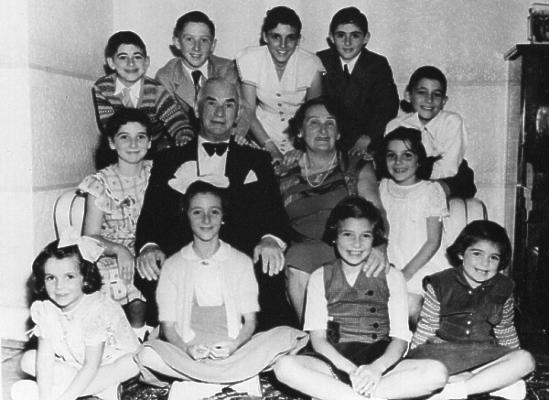
Back: Leib, Isaac & Harry
Front: Rachel, Chana Chesha Miriam, Nachum Mendel & Sarah
My dad Harry, me, my mother Rachel, my aunt Rachel and my bobba, Chana Chesha Miriam.
Here are a couple of pieces Rachel played when we visited her long after she retired.