A reminder that there are a number of South African KehilaLinks pages which can be found on the JewishGen’s KehilaLinks project web site. (The KehilaLinks project provides a set of web pages which commemorate the places throughout the world where Jews have lived.)
The full list of South African KehilaLinks pages can be found at:
http://kehilalinks.jewishgen.org/Asia.html
The list now includes the following towns: Benoni, Bloemfontein De Aar, Cape Town, Germiston, Graaff Reinet, Grahamstown, Kwekwe (Que Que) in Zimbabwe, Johannesburg, Kimberley, Muizenberg, Oudtshoorn Pietersburg, Port Elizabeth, Pretoria, Springs, Stellenbosch, Uniondale, Upington, and Witbank.
Eli Rabinowitz, who has created and maintains most of these KehilaLinks sites, is currently in the process of setting up the following new pages: Paarl, South Africa; Maputo, Mozambique; and Mauritius, Africa.
Eli invites you to send him your stories, memories, photos, family biographies, and articles on Jewish life in any of these places, or for any of the existing pages. As examples of the kind of material he is looking for, Eli suggests you refer to the following links:
For reference, the KehilaLinks project home page can be found at:
http://kehilalinks.jewishgen.org/
and
Lions Shul is a special place
The Lions shul is Johannesburg’s longest standing synagogue, still a vibrant, active, and dynamic congregation. The 108 year old synagogue is in pristine condition and the chavershaft (solidarity/equality) is warm and family-oriented. The services are inspirational and the ambiance magnificent.
A video about the synagogue can be found at:
A description of the synagogue on the Johannnesburg KehilaLinks page can be found at:
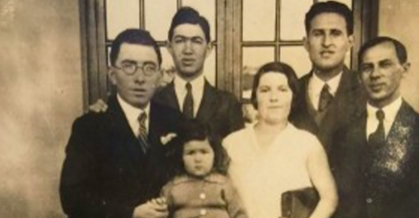
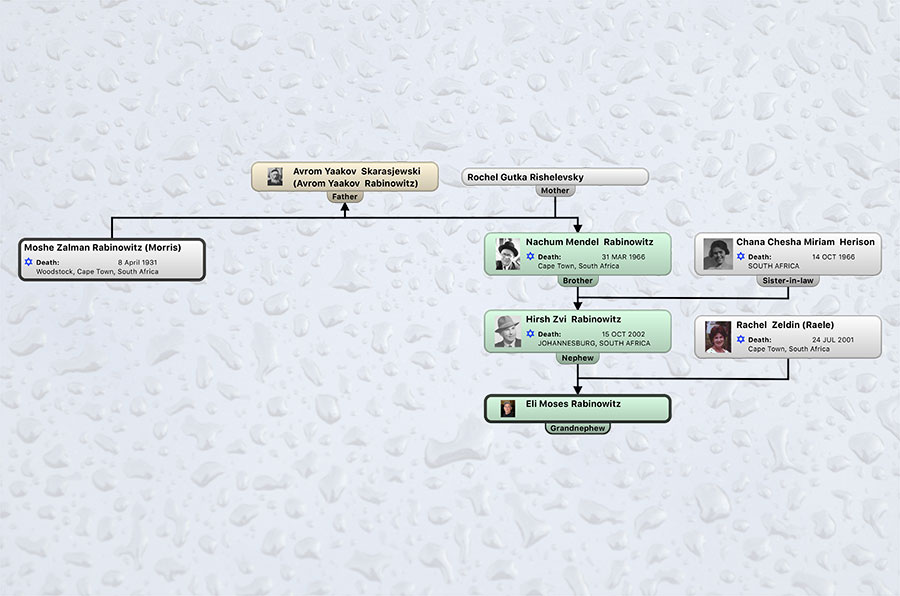
The story of how Eli Rabinowitz finally found his first cousin, Zara Smushkovich, after being separated for over 35 years
We love hearing stories of families reunited through Geni. Recently, Eli Rabinowitz finally found his first cousin Zara Smushkovich after being separated for over 35 years! The discovery was made thanks to the help of a friendly person on Facebook who found the family tree on Geni.
Eli is a Genealogist of note……….. Eli Rabinowitz – ‘Gib A Kuk’ at his blog…E-mazing news from ‘Der Heims’ & The ‘Beloved Country’…. http://elirab.me/
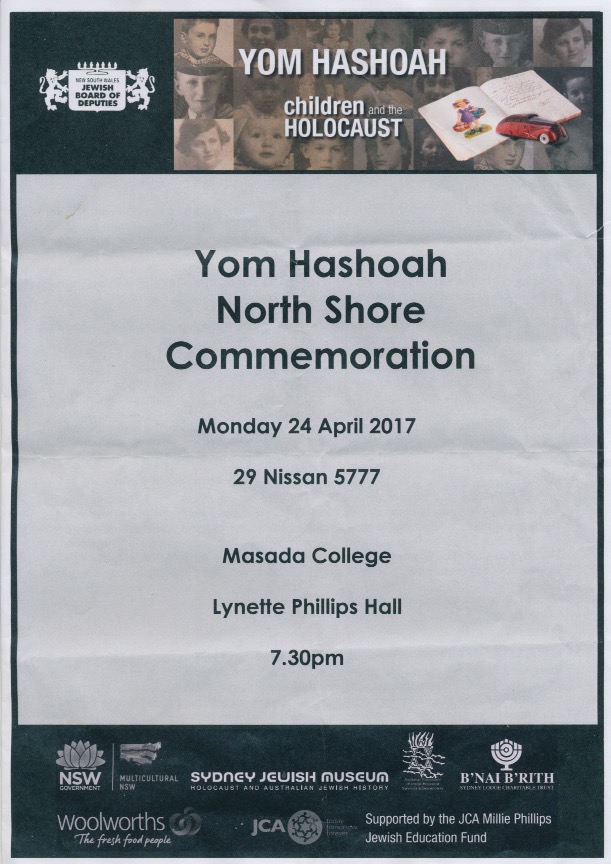
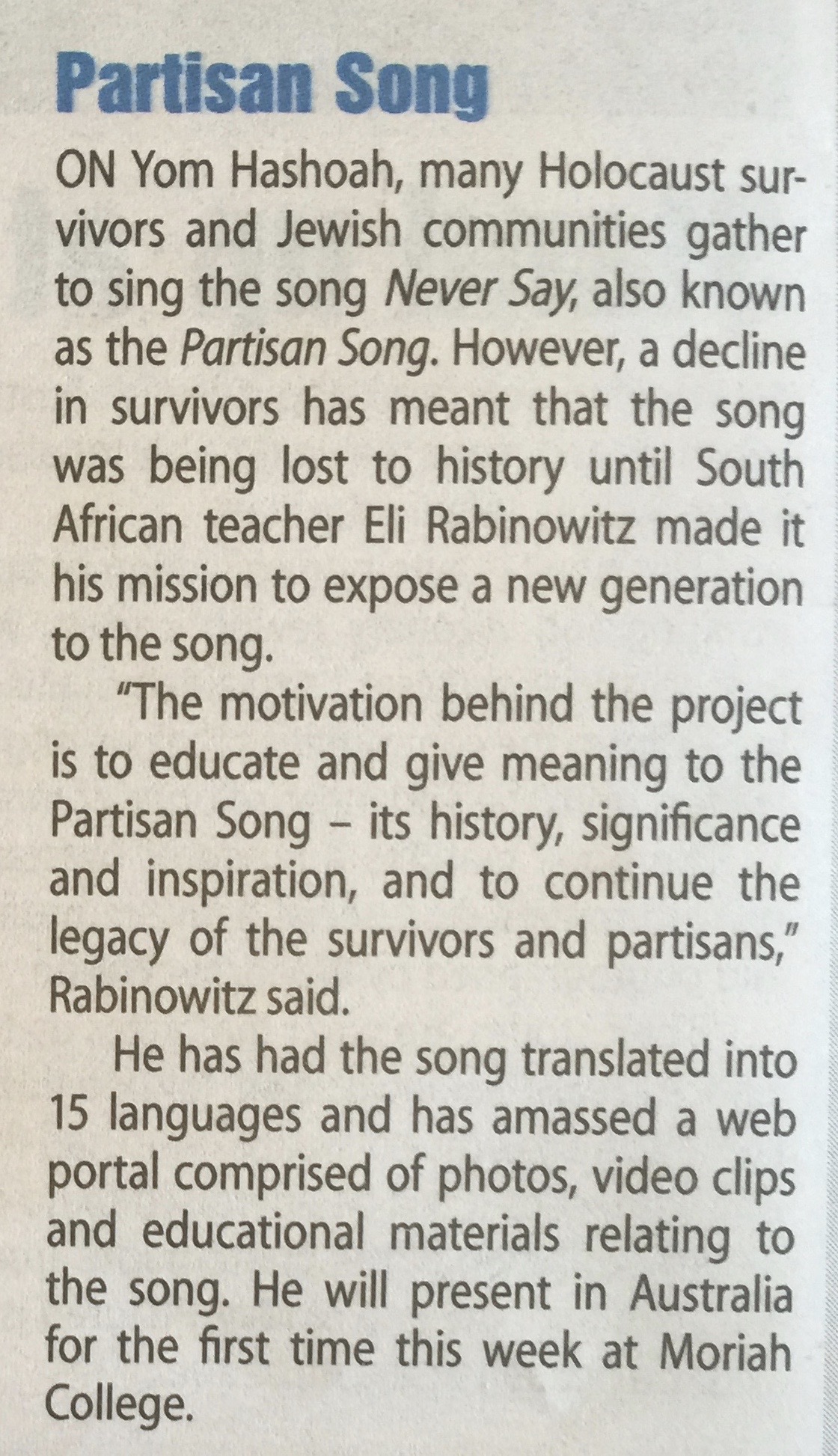
“Continue the Legacy of the Jewish Partisans and Survivors “From generation to generation” With less than a week to go to Yom Hashoah on 23/24 April, show your solidarity with Survivors by reciting the Partisan Song, Zog Nit Keynmol, in your own language” ……………….. YOM HASHOAH take place
Continue the Legacy of the Jewish Partisans and Survivors
With Don Krausz
“From generation to generation”
With less than a week to go to Yom Hashoah on 23/24 April, show your solidarity with Survivors by reciting the Partisan Song, Zog Nit Keynmol, in your own language.
Even better, record & share it on Facebook or Twitter. You can also Dropbox or email it to me at eli@elirab.com and I’ll upload it for you!
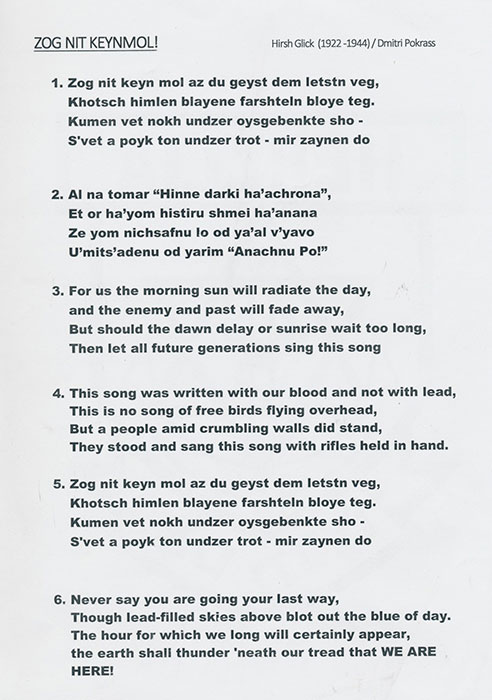
It can also be in a combination of languages such as Yiddish, Hebrew and English
Here are 15 different language versions for you to choose from:
http://elirab.me/lyrics/
Here is an example of a recitation:
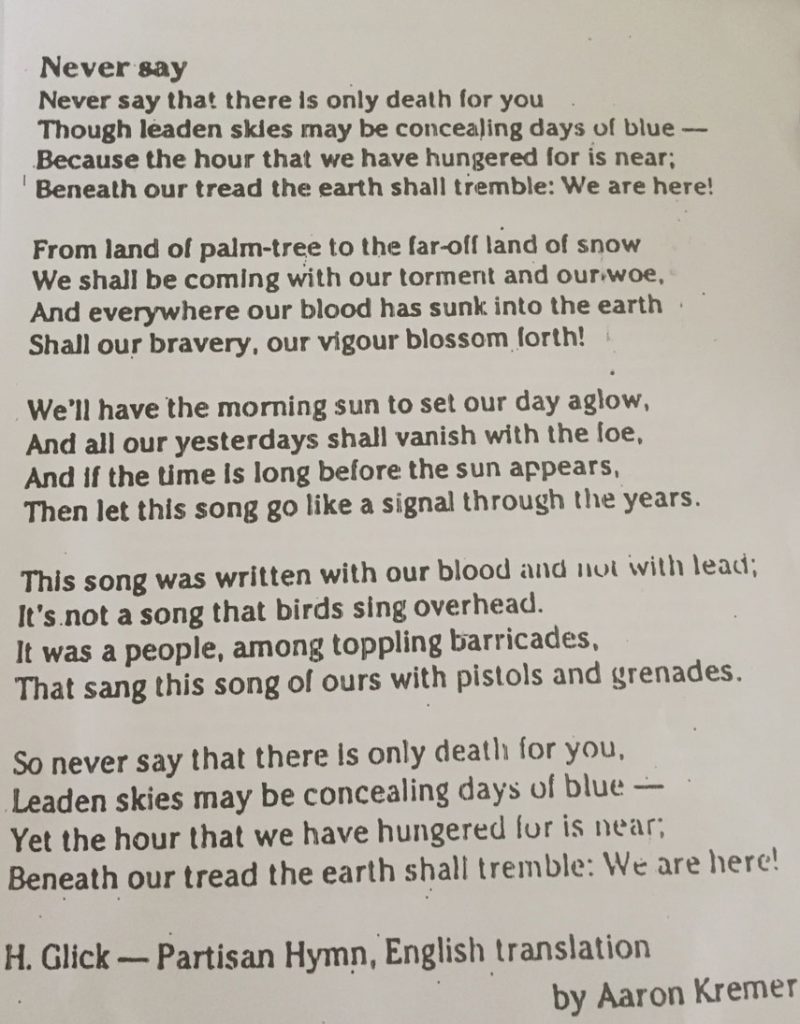
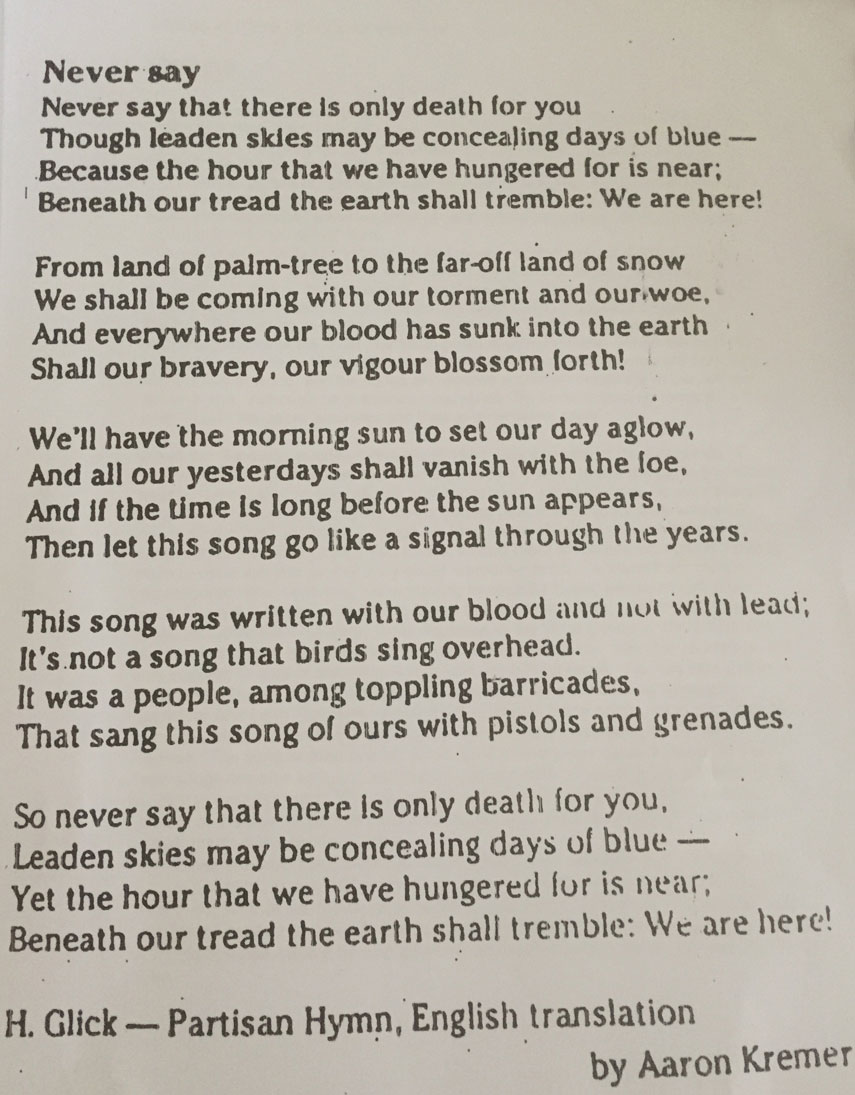
Freidi Mrocki, a teacher at Shalom Aleichem College in Melbourne, recites Aaron Kremer’s English translation:
Want to sing or recite it in Yiddish, Hebrew & English?
Encourage participation by your children and grandchildren by learning the song and its meaning.
Encourage your school or shul choir to learn and to sing it.
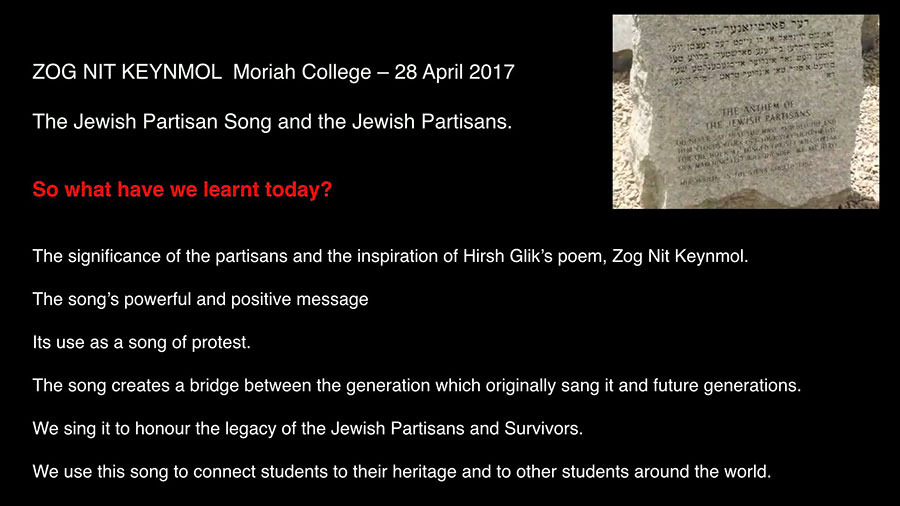
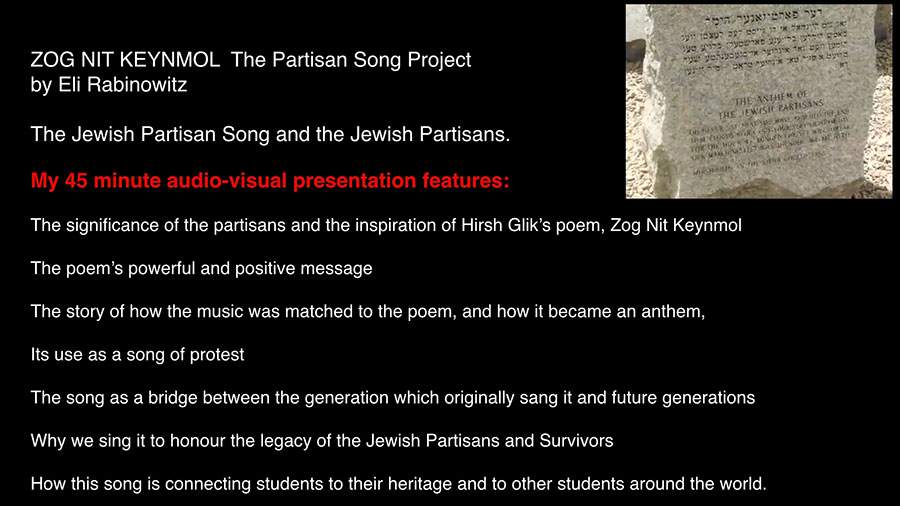
Zoe Nit Keynmol was written as a poem in Yiddish by 20 year old Hirsh Glik in the Vilna ghetto in 1943.
The words are powerful and inspirational.
It is the anthem of the Survivors. Our goal is to teach it to the next generation of school students so that the legacy can continue!
I have found translations in 14 other languages with some variations within these languages – see Lyrics below.
You can recite it as a poem as it was originally written!
Here is Freidi Mrocki, a teacher at Shalom Aleichem College in Melbourne, reciting Aaron Kremer’s English translation.
Zog Nit Keynmol – The Poem
Here is an idea for your school students or youth group: Recite the poem, Zog Nit Keynmol, written by Hirsh Glik 20, in the Vilna ghetto in 1943. Do it in your own language! And then SHARE it with …
Here is a combination of Yiddish, Hebrew and English.
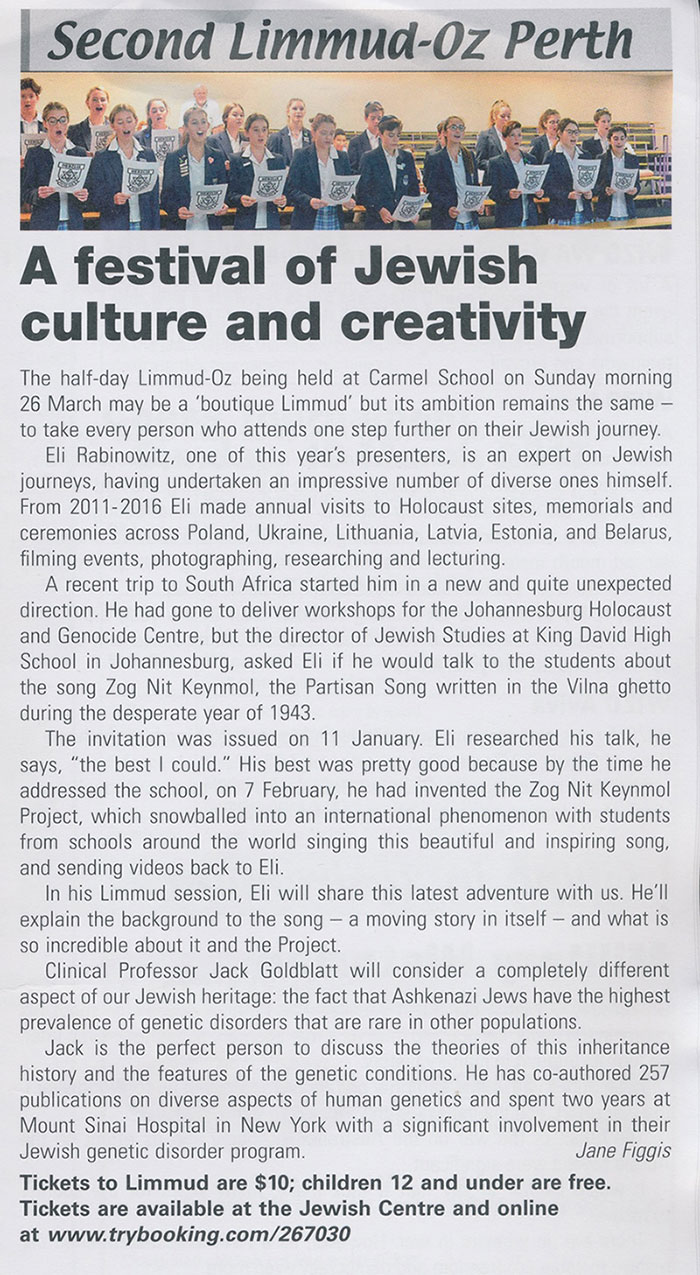
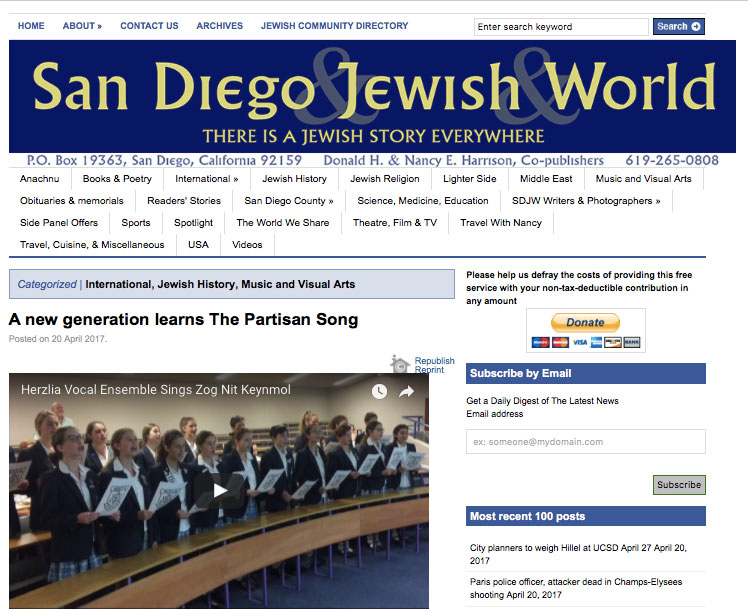
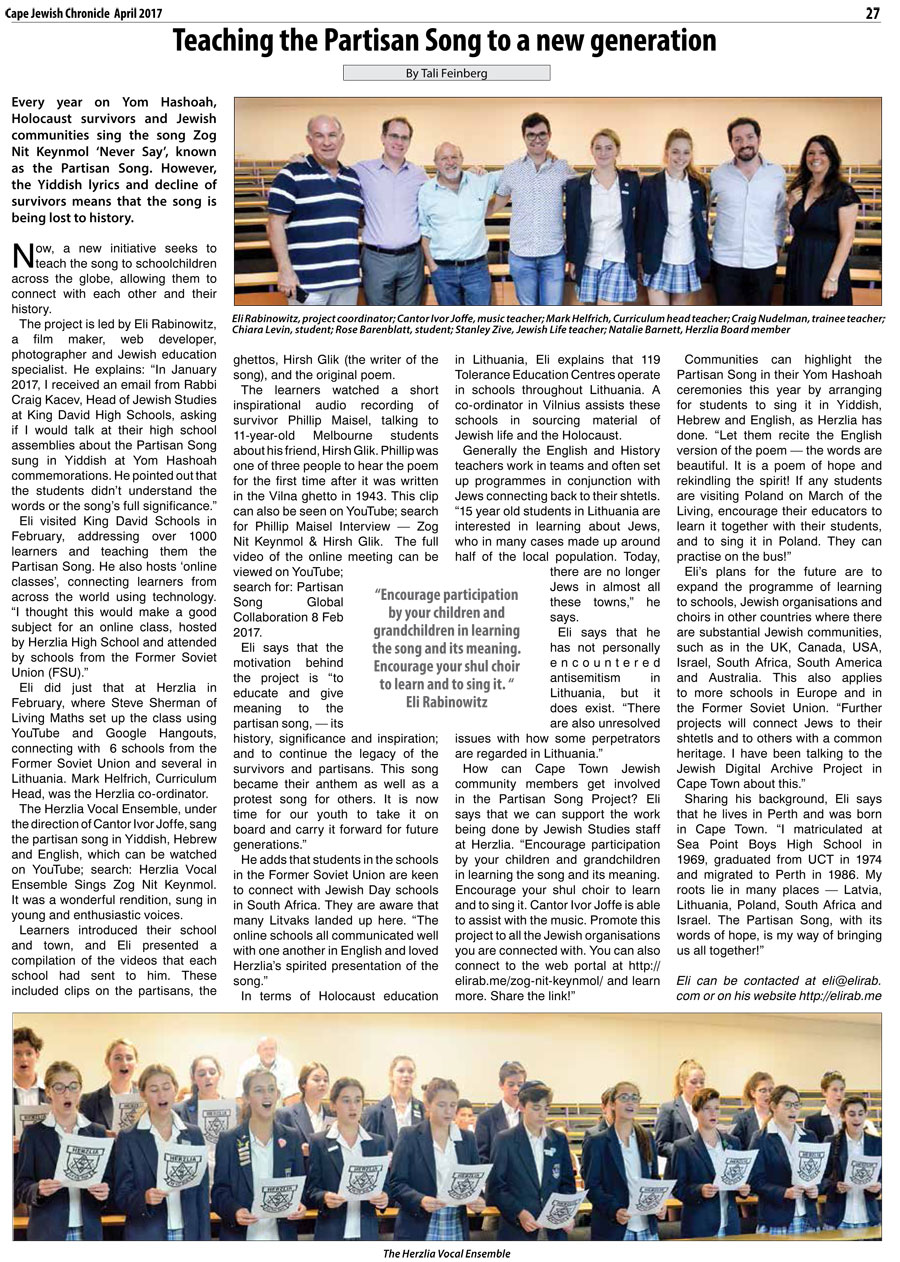
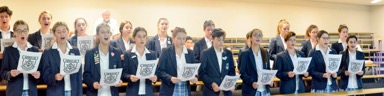
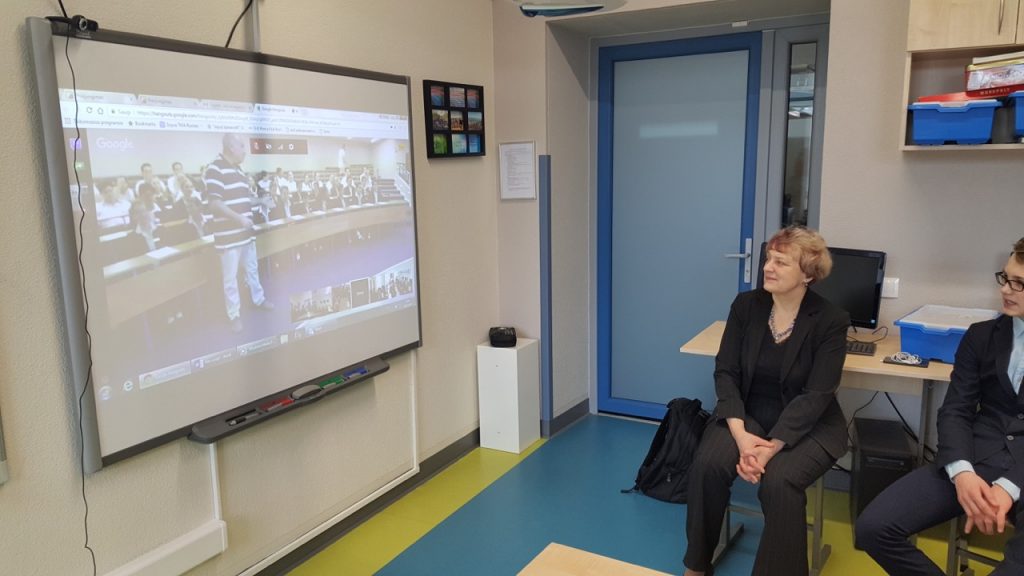
Here it is being sung by the Herzlia School Vocal Ensemble in Cape Town during an online class with five schools in the Former Soviet Union in Kiev, Chisinau, Vilnius, Kedainiai and Kalvarija.
For more languages and versions, click on the link:
Lyrics
Lyrics in Different Languages English Aaron Cremer’s version Lithuanian Žydų Partizanų Daina arba Partizanų Himnas Mes Esame Čia Niekad nesakykite kad jūs išeinate į paskutinį kelią… Tik nie…
We invite you, your school choir or group to sing or recite Zog Nit Keynmol, the Partisan Song. Please record it then share on YouTube, Facebook or Vimeo or send to me by Dropbox and I’ll pos…
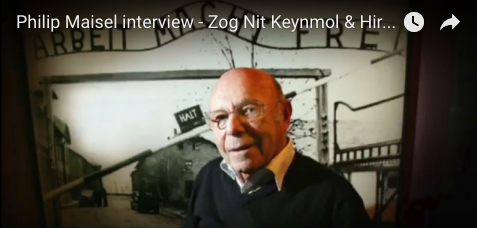
Menu Zog Nit Keynmol – Main Page – scroll down The Legacy of the Partisan Song Hirsh Glik by Phillip Maisel Schools & students sing or recite the anthem, record it and post it on…
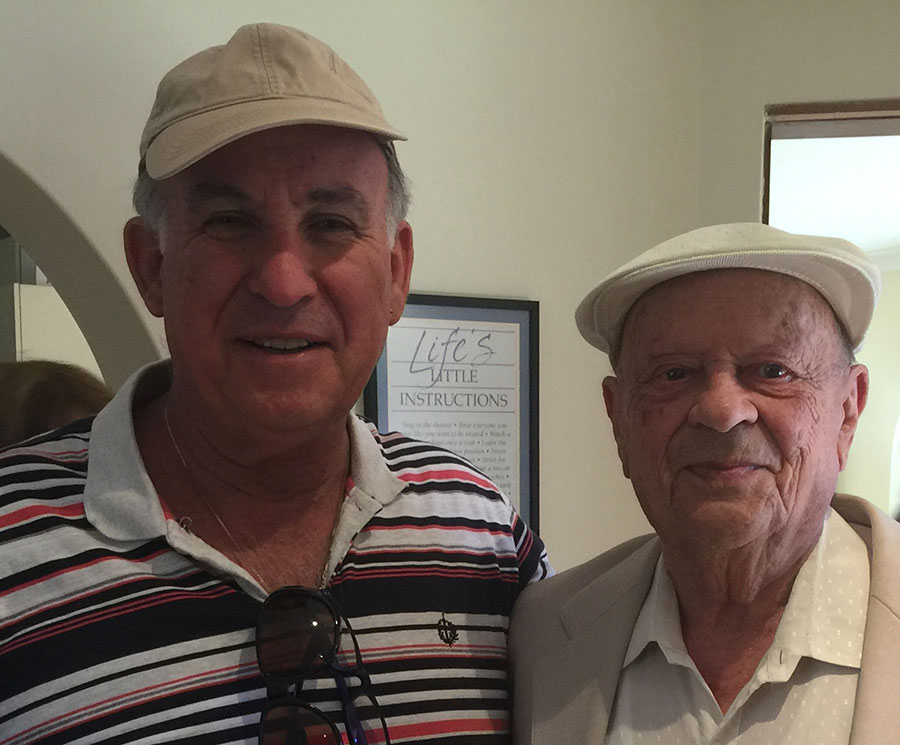
Below is a video of Freidi Mrocki reciting the poem in English. Freidi is the teacher at Sholem Aleichem College in Melbourne, who recorded the interview with Phillip Maisel in 2015.
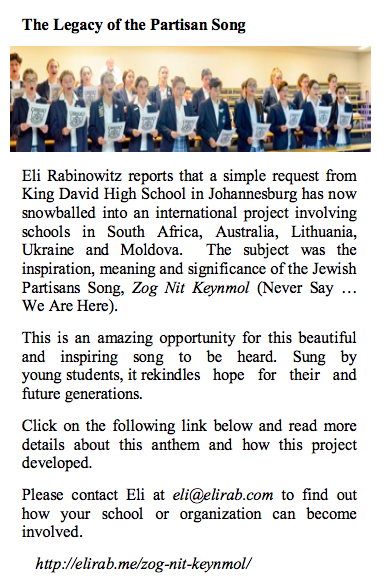
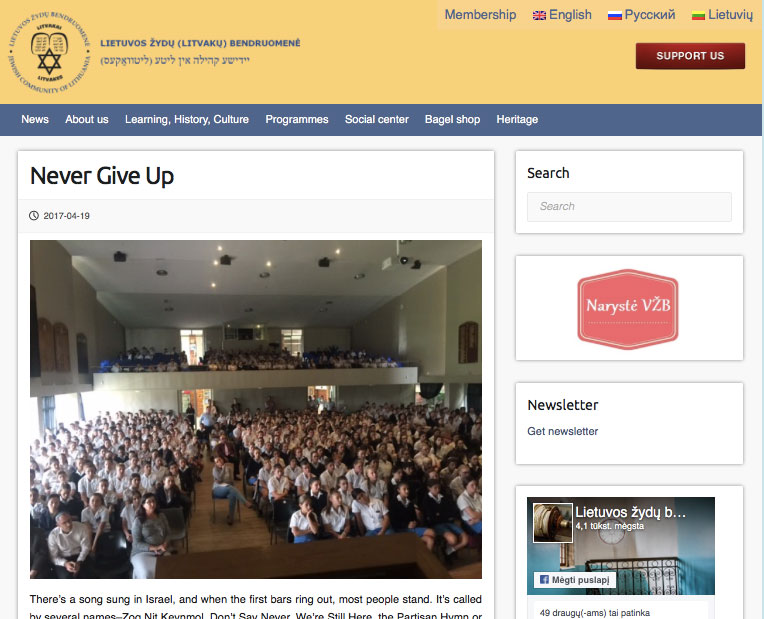
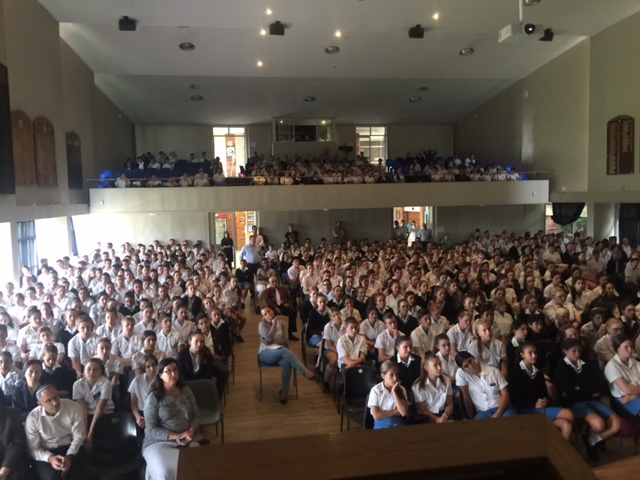
A simple request from King David High School in Johannesburg has now snowballed into an international project involving schools in South Africa, Australia, Lithuania, Ukraine and Moldova.
This is an amazing opportunity for this beautiful and inspiring song to be heard. Sung by young students, it rekindles hope for their and future generations.
Please contact me at eli@elirab.com to find out how your school or organisation can become involved.
Click on the link below and read more details about this anthem and how this project developed.
Click here Zog Nit Keynmolfor more details on the project and videos used in the presentation.
ORT Solomo Aleichemo, Vilnius, Lithuania
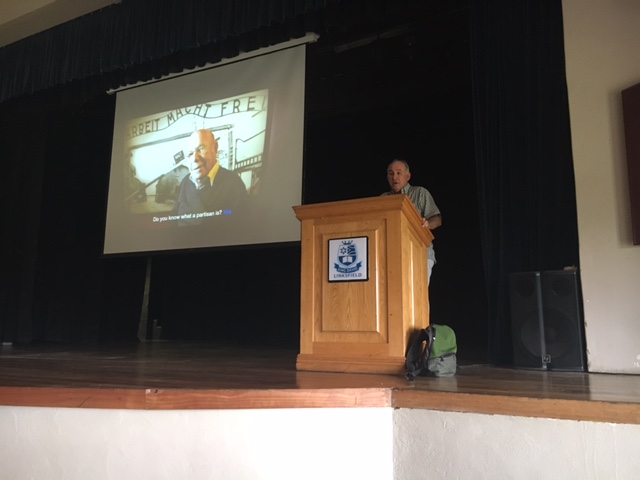
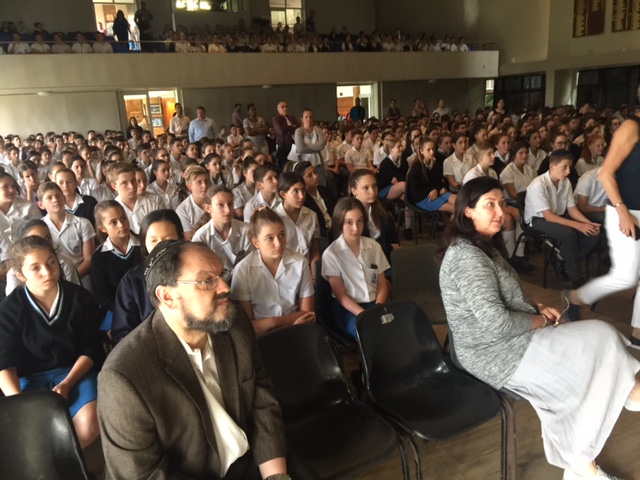
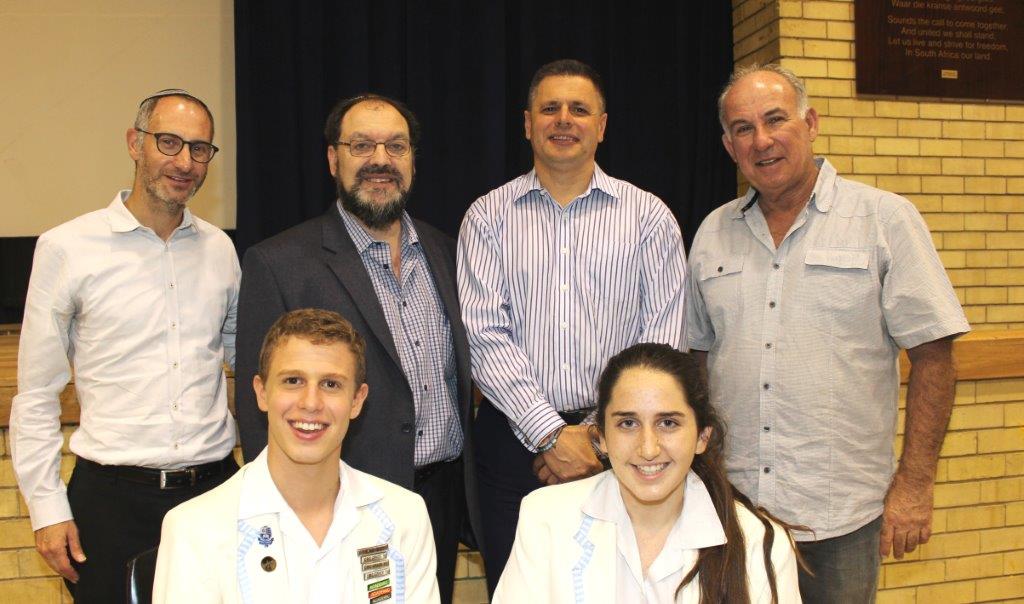
On 11 January 2017, I was asked by Rabbi Craig Kacev, head of Jewish Studies at King David Schools, Johannesburg, South Africa, whether I could make a presentation to the students at the Linksfield…
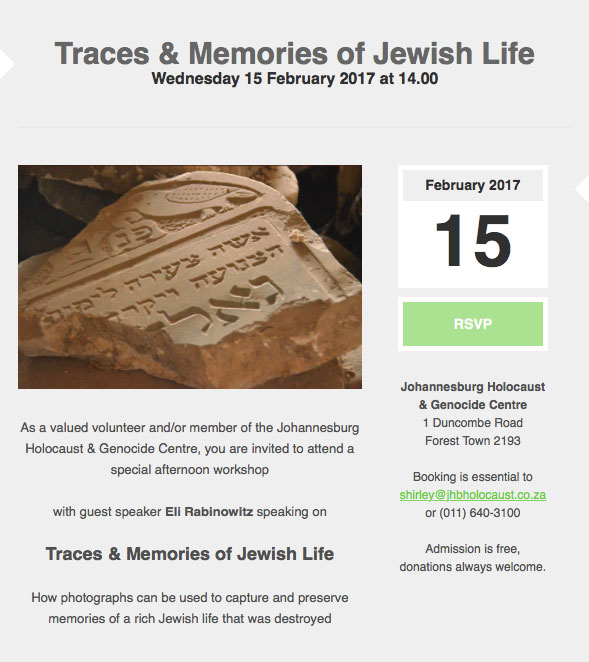
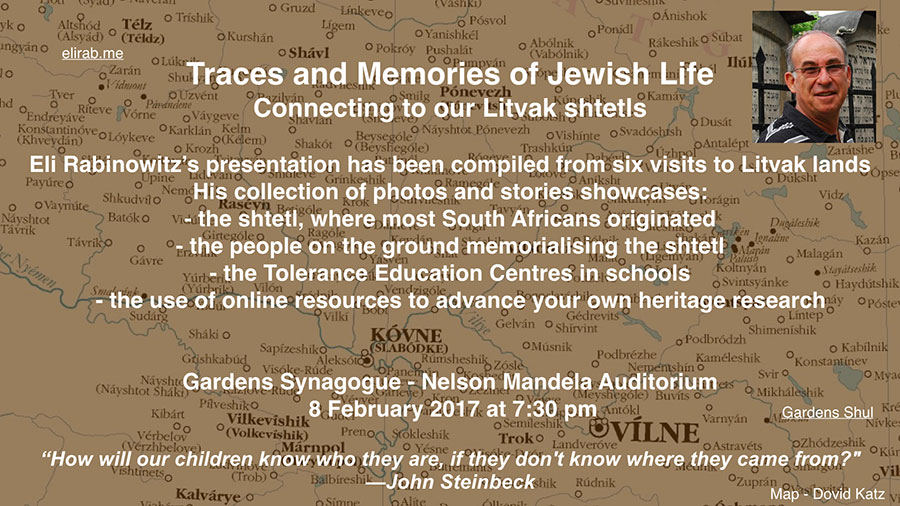
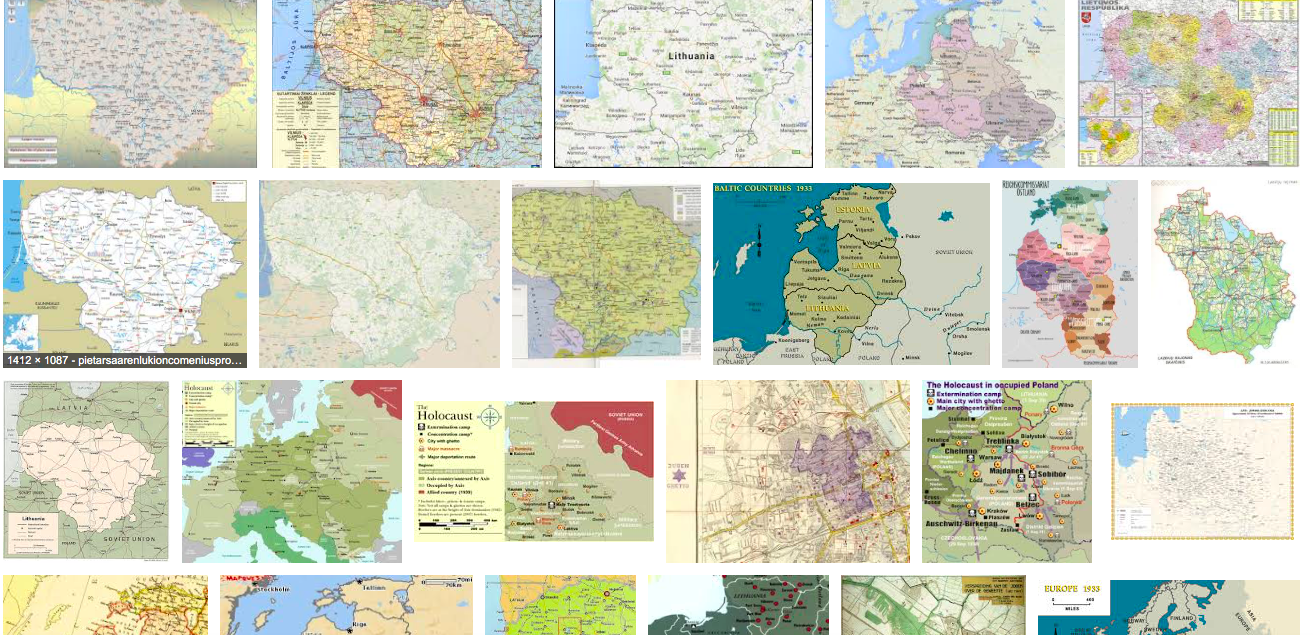
Traces and Memories of Jewish Life Connecting to our Litvak Shtetls
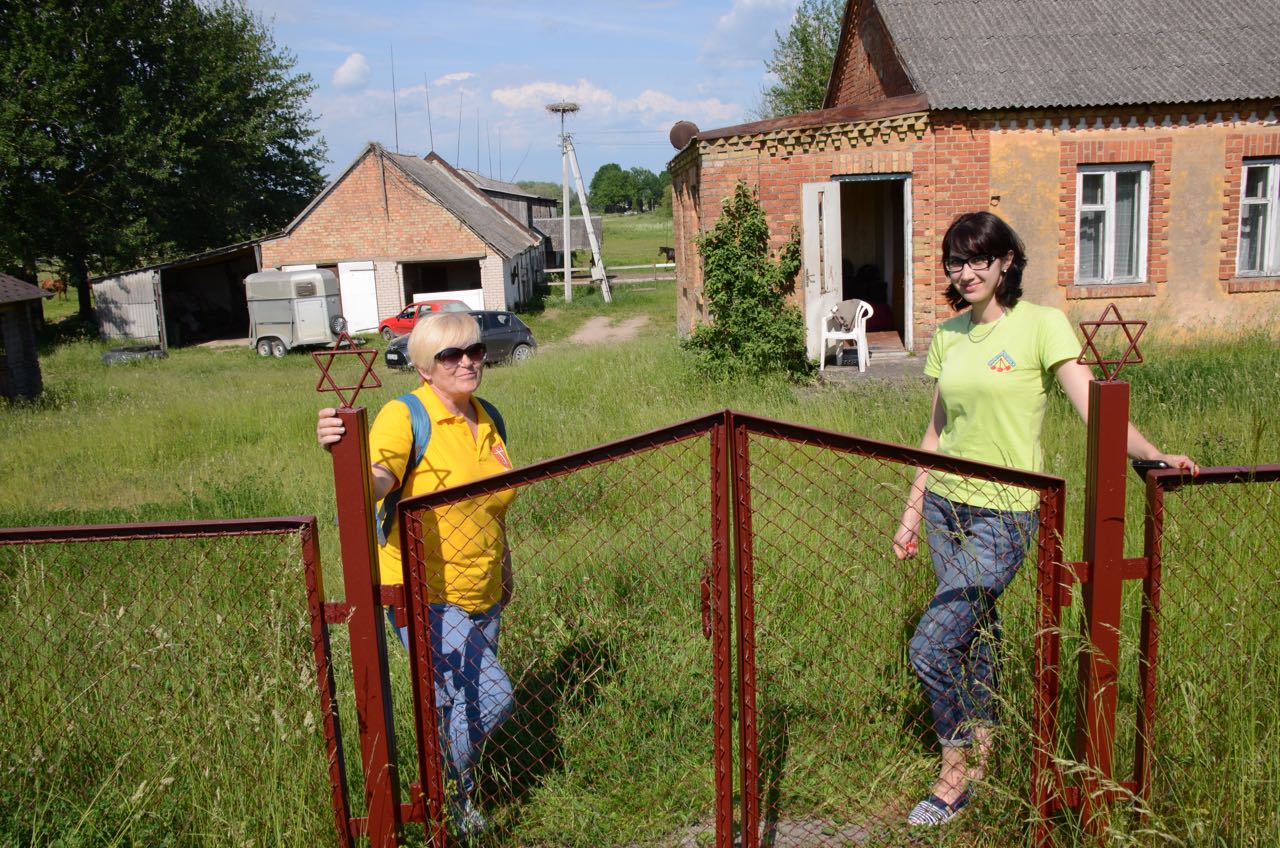
Eli Rabinowitz’s presentation has been compiled from six visits to Litvak lands.
His collection of photos and stories showcases:
– the shtetl, where most South Africans originated
– the people on the ground memorialising the shtetl
– the Tolerance Education Centres in schools
– the use of online resources to advance your own heritage research
“How will our children know who they are, if they don’t know where they came from?” —John Steinbeck
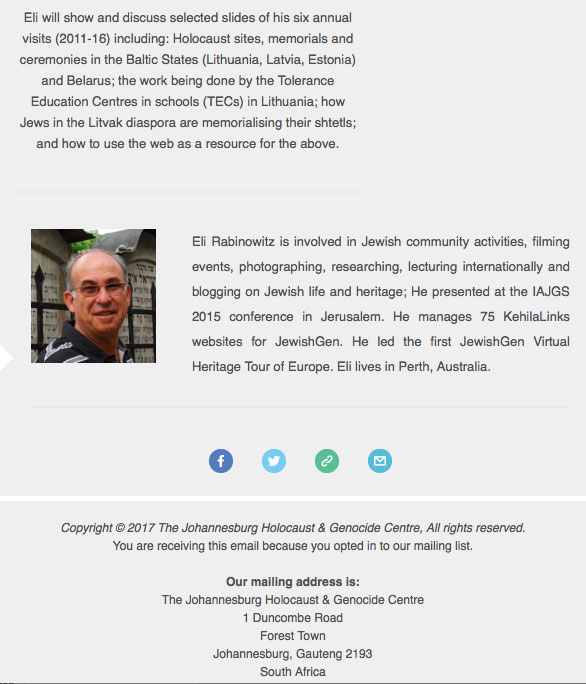
Eli Rabinowitz (ex- South Africa) is involved in Jewish community activities, filming events, photographing, researching, lecturing internationally and blogging on Jewish life and heritage. He presented at the IAJGS 2015 conference in Jerusalem. He manages 76 KehilaLinks websites for JewishGen. He led the first JewishGen Virtual Heritage Tour of Europe. Eli lives in Perth, Australia.
WHEN: Sunday 5 February at 7.30pm DONATION: R90.00 (including refreshments) VENUE: Clive M Beck Auditorium Rabbi Cyril Harris Community Centre (RCHCC) cnr Glenhove Rd & 4th Street Houghton, East of the M1 BOOKING: Hazel or René (011 728 8088/8378) After Hours (011 728 8378) email: rchcc@telkomsa.net or rene.s@telkomsa.net www.greatpark.co.za
Eli Rabinowitz’s presentation has been compiled from six visits to Litvak lands
His collection of photos and stories showcases:
– the shtetl, where most South Africans originated
– the people on the ground memorialising the shtetl
– the Tolerance Education Centres in schools
– the use of online resources to advance your own heritage research
Gardens Synagogue – Nelson Mandela Auditorium
8 February 2017 at 7:30 pm
My Upcoming Talks at the Great Park & Gardens Shuls
Traces and Memories of Jewish Life Connecting to our Litvak shtetls The Great Park Synagogue RCHCC, Johannesburg 5 February 2017 at 7:30pm and The Nelson Mandela Auditorium at the Gardens Shul, C…