Remembering Uncle Moisey

IMG_6012ss

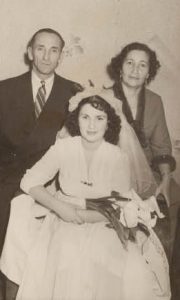
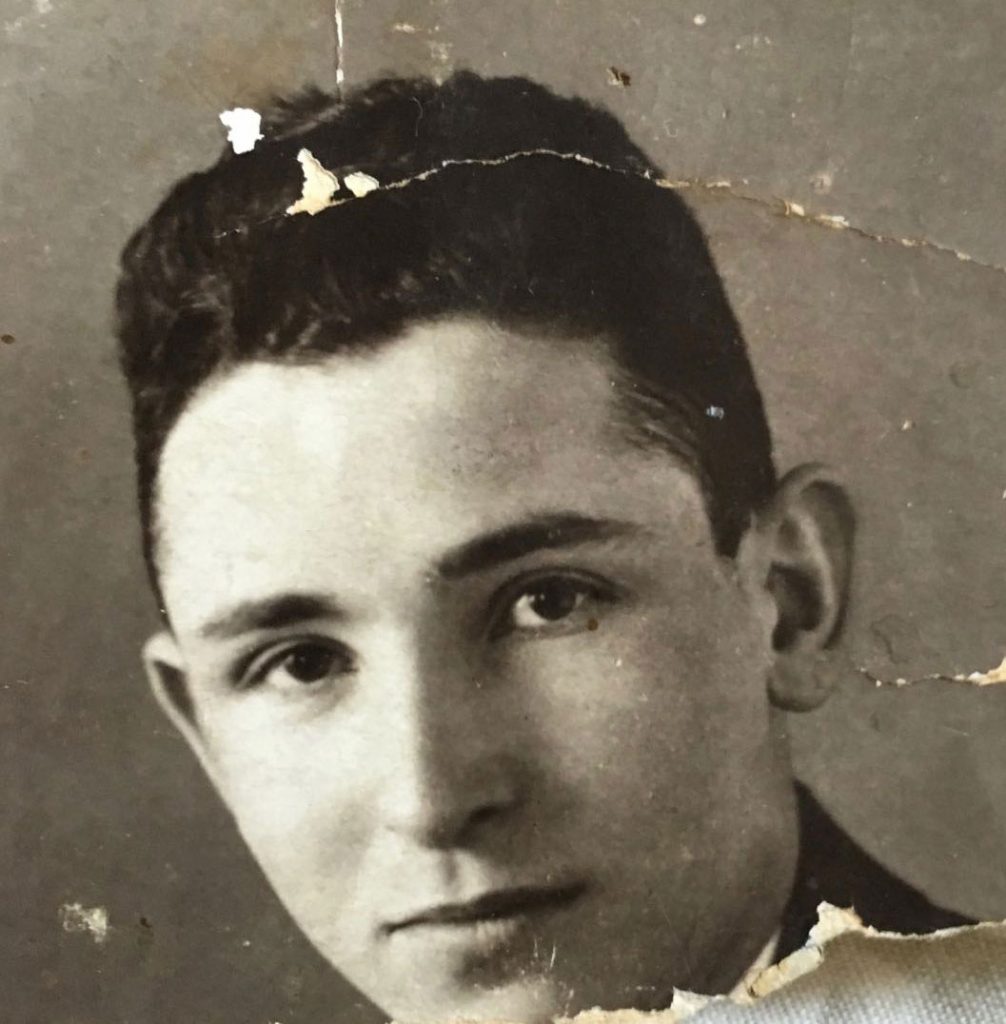
Is this Uncle Moisey, my mother’s brother?

There is nobody alive today who can tell us his story or would recognise his image! As kids, my cousins and I were told that he perished in the Holocaust in Latvia.

With his generation now gone, no one can remember the details.

My cousin Sonia Bloch and I found this photo recently  – we believe it is Moisey Zeldin!

In 2011 I commissioned Rita Bogdanova of the Latvian State Archives in Riga to research my mother’s family.

This is what she found specifically about Moisey.

Moisey’s parents (my grandparents):

1.5 Ishochor (Zachar) Zeldin  a petty bourgeois from Dvinsk, aged 23, married on May 22, 1905 in Riga to Hasia Jonje  – Hase Jonin, daughter of Jossel Jonin, a petty bourgeois from Dvinsk, aged 20, and marriage was registered in the marriage records of the Riga Jewish community for 1905. Ktuba – 100 rubel. Isochor and Hase:

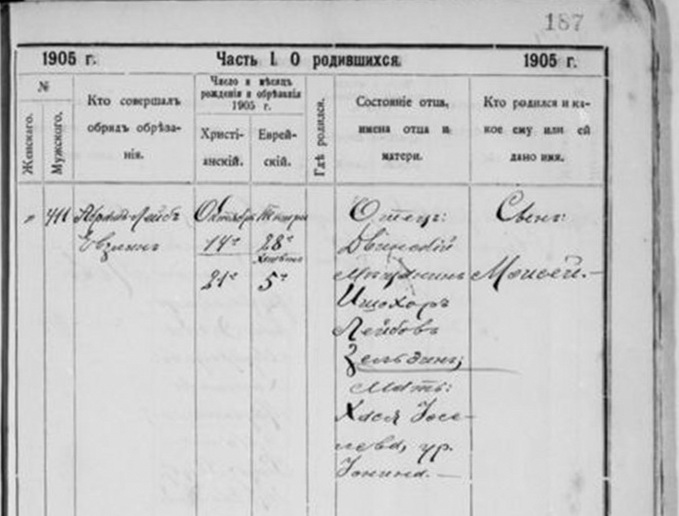
1.5.1. son Moisey Zeldin, born on October 14, 1905 in Daugavpils (see copy of his birth registration entry). He was not married, lived in Riga at Parka Street 1–4  and Lačpleša Street 129–4.
 

Moisey_birth_registration_1905

Birth registration entry Nr. 411 in the birth records of the Dvinsk Jewish community for 1905:

Moisey Zeldin was born on October 14, circumcised on October 21, 1905 (Julian calendar) by Abram Leib Evzin.

Father – Dvinsk petty bourgeois Isochor son of Leib Zeldin.

Mother – Hasia daughter of Josel Jonin.


My mother, her 5 sisters and parents were all in South Africa by 1937.
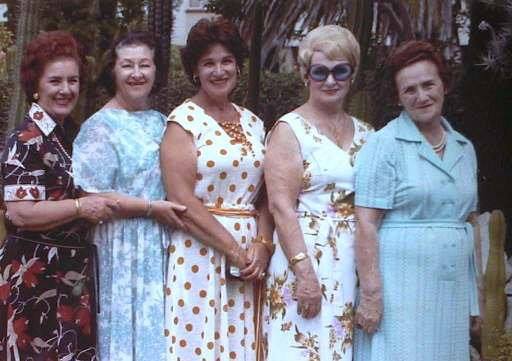
Sisters

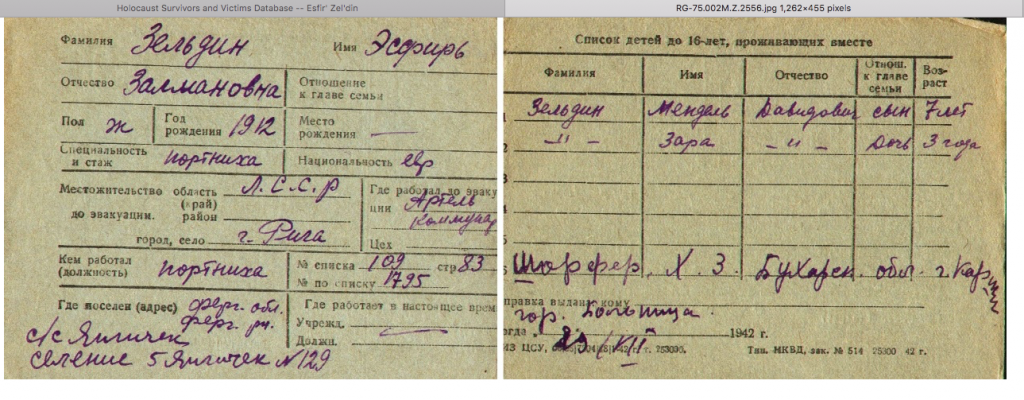
Moisey’s brother David somehow survived, as did David’s wife Esther and their two children who escaped to Tashkent, Uzbekistan.

All members of the family were struck off the house-register of Lačpleša Street 129–4 on June 26, 1941 which means that they had fled.

Screen Shot 2016-05-05 at 2.42.41 PM

Screen Shot 2016-05-05 at 2.16.24 PM

David, his wife and  children were living back in Riga when my late cousin, Phyllis Jowell met them in 1960.
Mrs_Jowell's-Diary-headerDavid Esther & Sophka Wedding

Esther and her daughter Sofka were last seen in Israel in the early 1980s. They then moved to Canada.

We have lost contact!
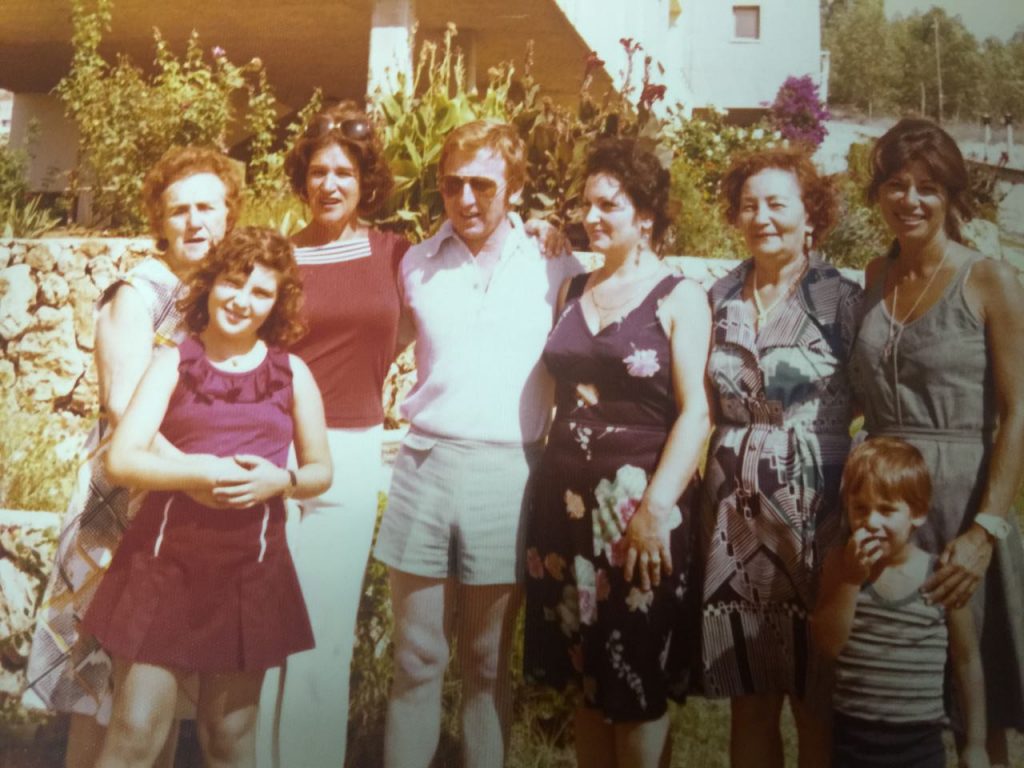
IMG_2306

In the last few months, I wrote to the Names and Fates Project so that they could update their database at:
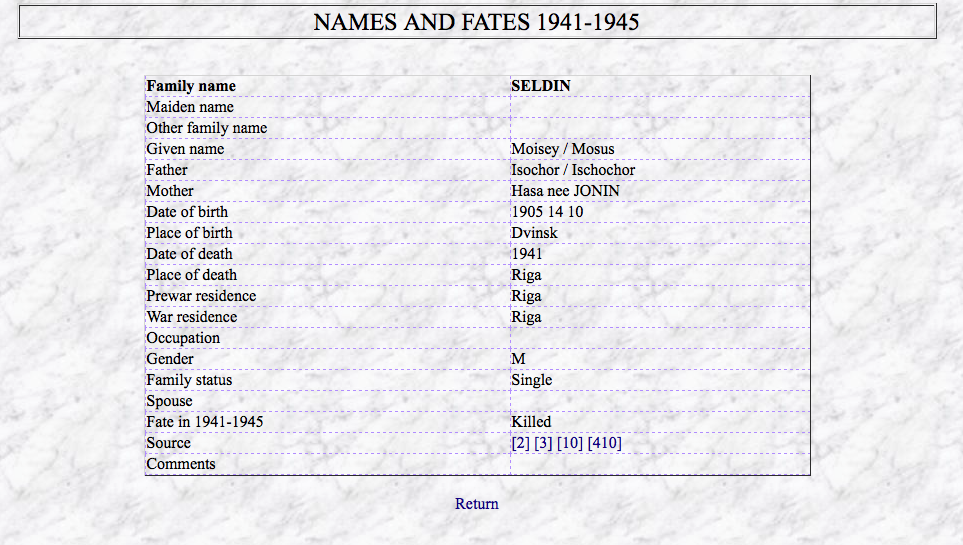
http://names.lu.lv/en.html

Screen Shot 2016-05-05 at 1.07.44 PM

http://names.lu.lv/cgi-bin/one?lang=en&code=889014574631


I now have written to Yad Vashem to include Moisey on their database of Jews who perished in the Holocaust.


TestimonyPage_17032016_70124

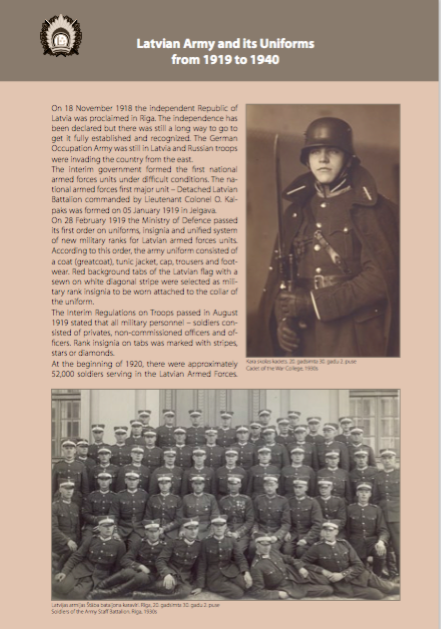
In Latvian Army uniform

IMG_6011

Latvian Army Uniform

We remember Moisey today on Holocaust Remembrance Day


The Boerejode of the Boland

IMG_3615

A visit to Cape Town is not complete without a drive to one of the towns in the Boland.

From Wikipedia:

Boland, Western Cape

The Boland (Afrikaans for “top country” or “land above”[1]) is a region of the Western Cape province of South Africa, situated to the northeast of Cape Town in the middle and upper courses of the Berg and Breede Rivers, around the mountains of the central Cape Fold Belt. It is sometimes also referred to as the Cape Winelands because it is the primary region for the making of Western Cape wine.

Although the Boland does not have defined boundaries, its core lies around the towns of StellenboschPaarl and Worcester. It may be understood to extend as far as MalmesburyTulbaghSwellendam and Somerset West. This is approximately the area included in the Cape Winelands District Municipality, which was formerly called the Boland District Municipality. To the southwest lies the Cape Town metropolitan area, to the northwest the Swartland and West Coast, to the northeast the Great Karoo, to the east the Little Karoo, and to the south the Overberg.

The “Boland” name is given to a number of sports teams from the region, including the Boland cricket team and the Boland Cavaliersrugby union team.

IMG_3614

Many of the Jews who came to Africa from Europe settled in rural areas and small dorps. They formed a subculture within the Afrikaner environment of these towns and many were known as Boerejode, Afrikaner Jews or more literally “farmer Jews”.

These towns could be regarded as Africa’s version of the shtetl back in Eastern Europe.

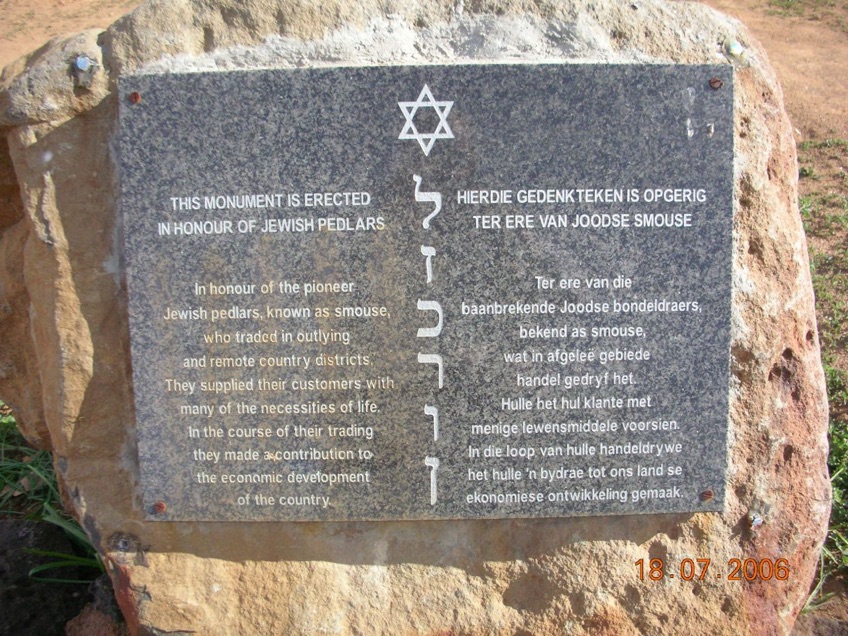
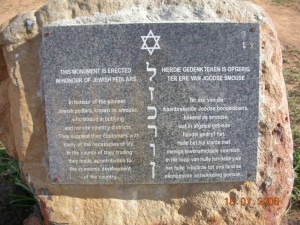
In the earlier years of settlement,  there was the Jewish pedlar or smous, who travelled from town to town, farm to farm, selling his wares. Here is a memorial to the smous or pedlar on my new Graaff Reinet KehilaLink:

DSCN1021

http://kehilalinks.jewishgen.org/graaff_reinet/Smouse.html

Below you will find a selection of my images of Stellenbosch, one of the main towns of the Boland with its striking mountains, rich winelands and outstanding Cape Dutch architecture.

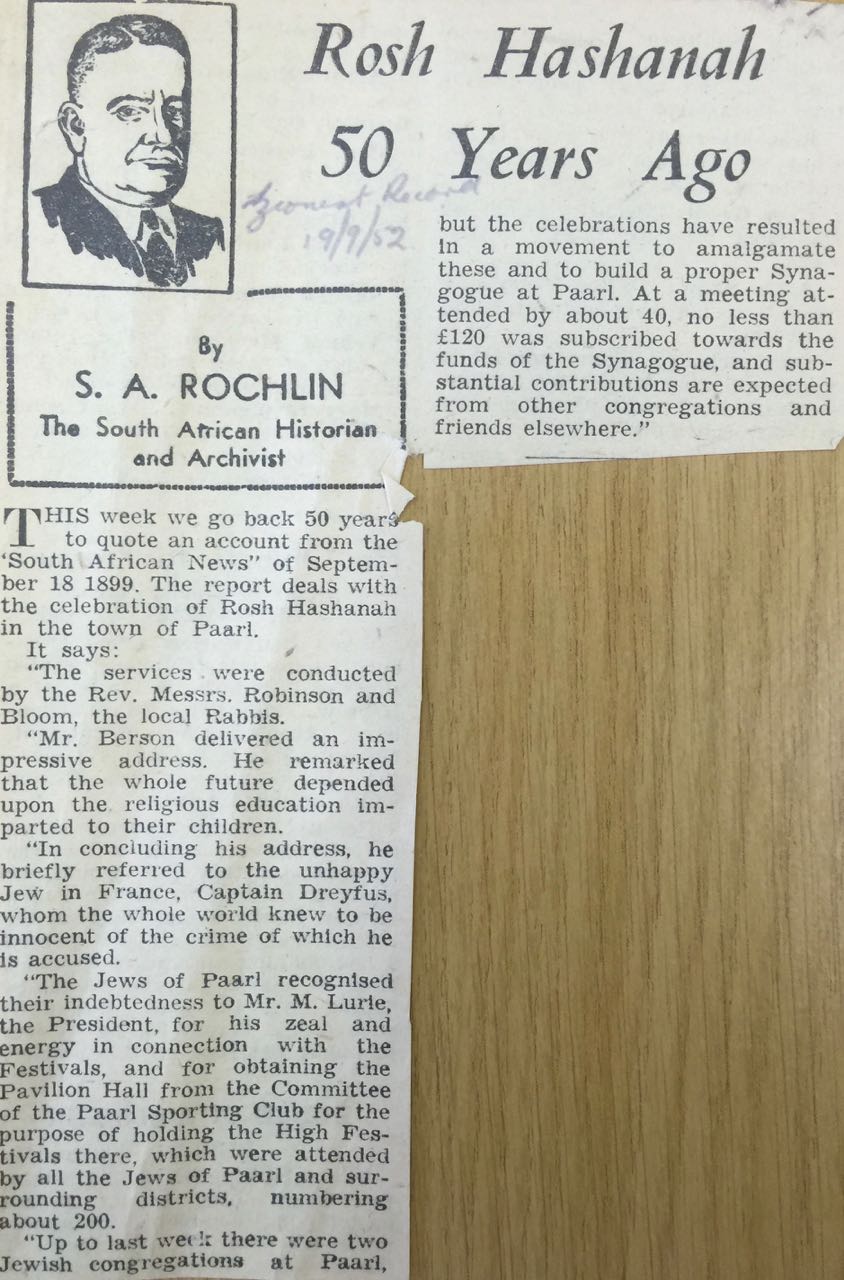
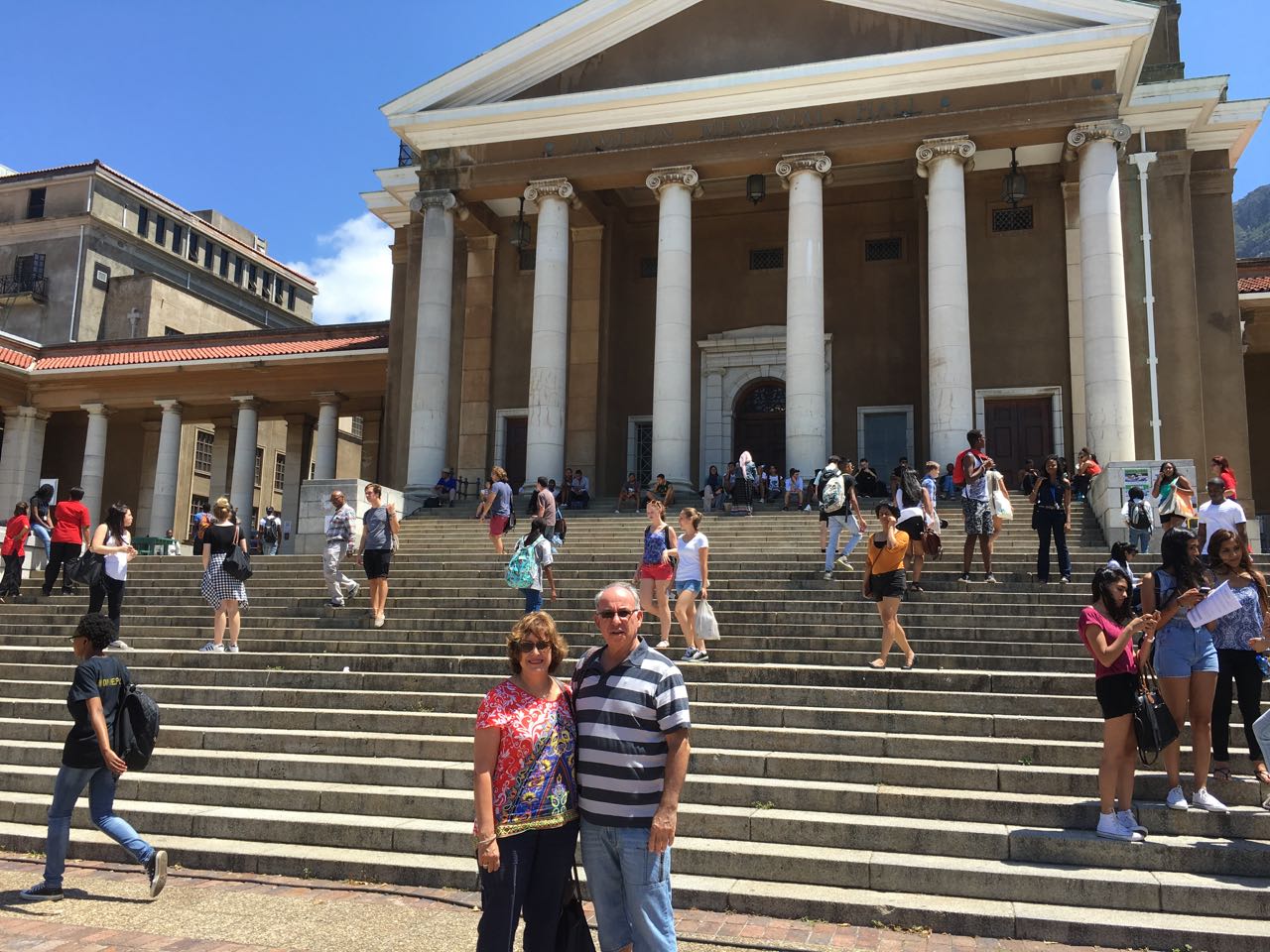
I have also included some interesting articles which I found at the Kaplan Centre archives at UCT, the Univeristy of Cape Town, my alma mater!

A big thank you to Juan-Paul Burke, the librarian at the Kaplan Centre, always so obliging and helpful, for allowing me to use them.

And on a tangent – on campus there was no sign of Cecil John Rhodes, except for the old signs!

Boerejood

in Wikipedia, die vrye ensiklopedie


Afrikaner-Jews

From Wikipedia, the free encyclopedia

According to the South African Jewish Museum, “Many of the later immigrants arrived with no resources other than their wits and experience. Most could not speak English when they arrived. Often they would learn Afrikaans before English. Their households were often multi-lingual, with parents speaking Yiddish and Afrikaans, and the children learning English at school.”[citation needed]

The University of Cape Town Jewish Studies library has a comprehensive collection of South African Yiddish books. Its collection of Yiddish periodicals is, however, not as comprehensive.

Famous Afrikaner-Jews

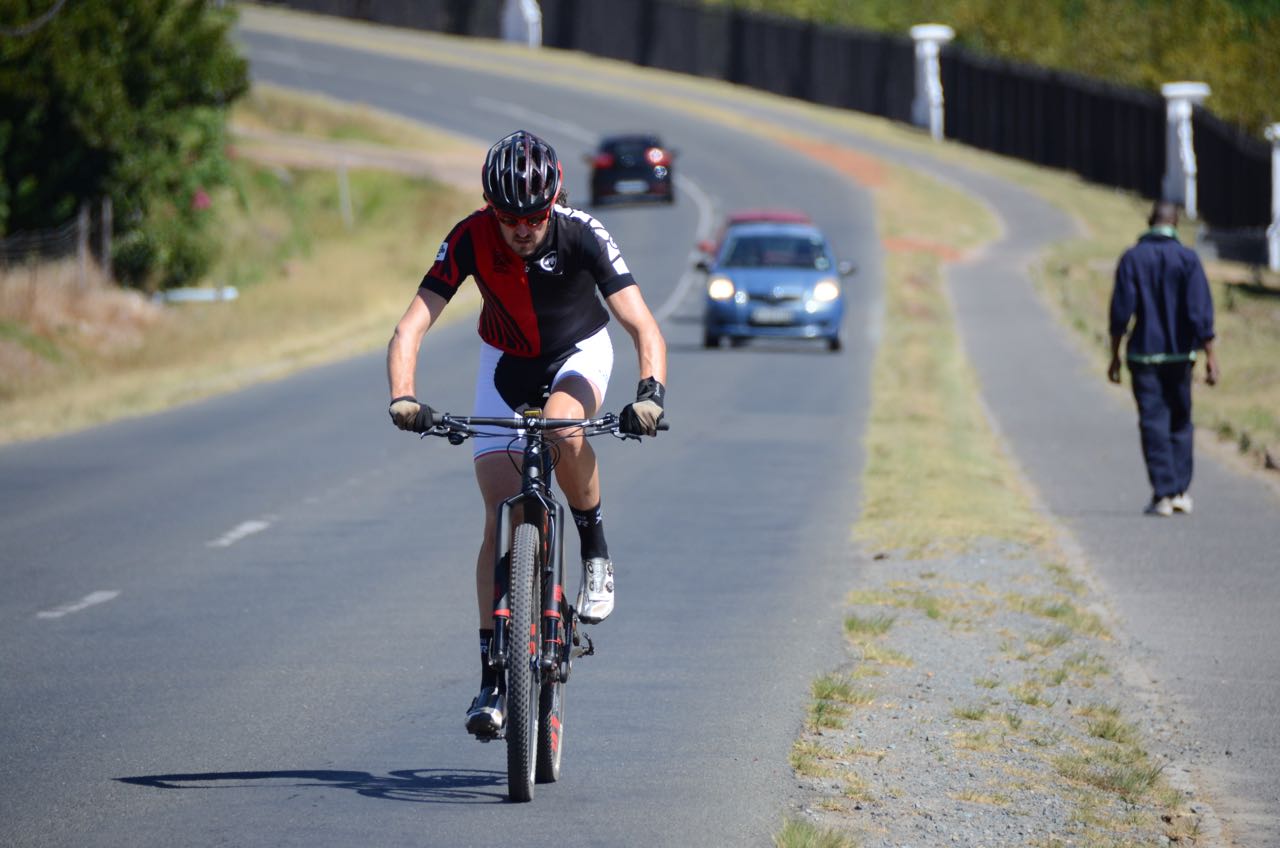
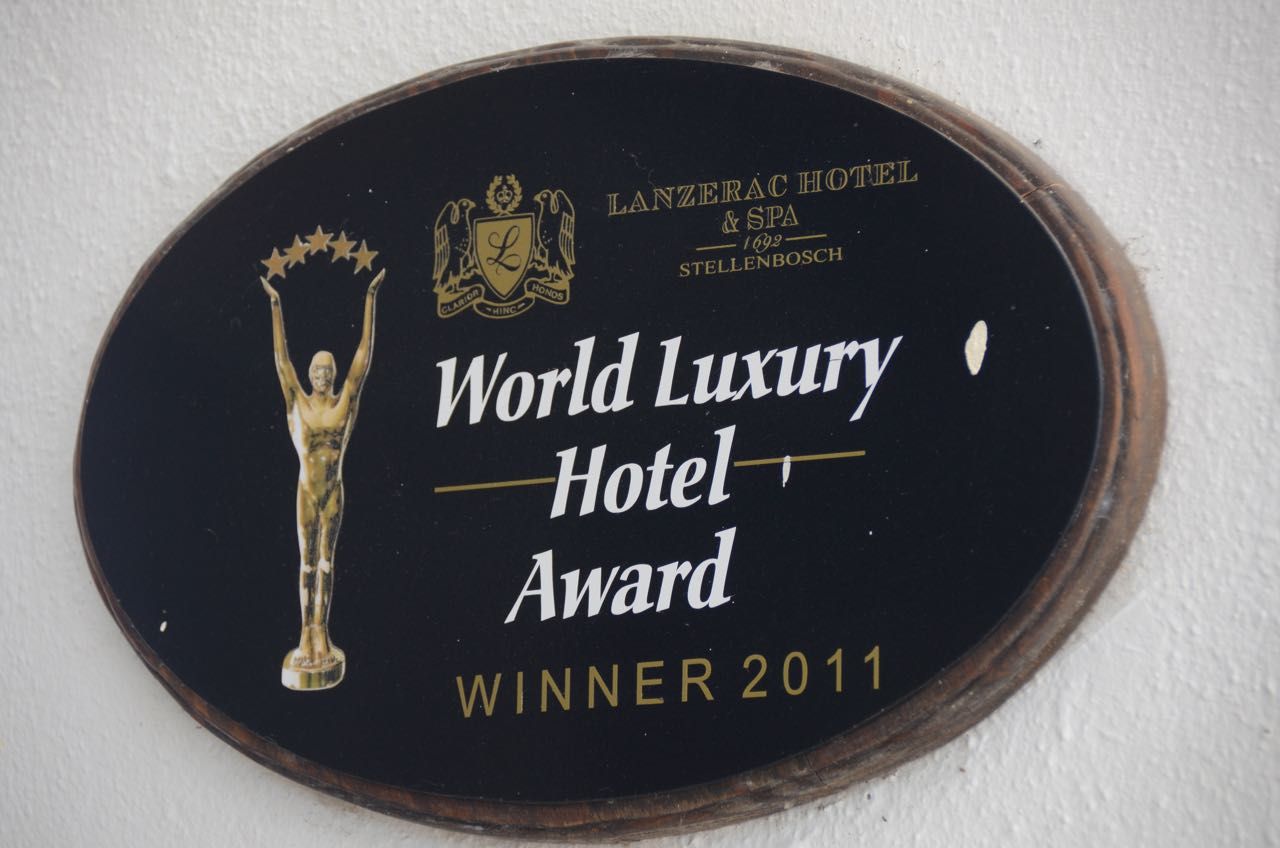
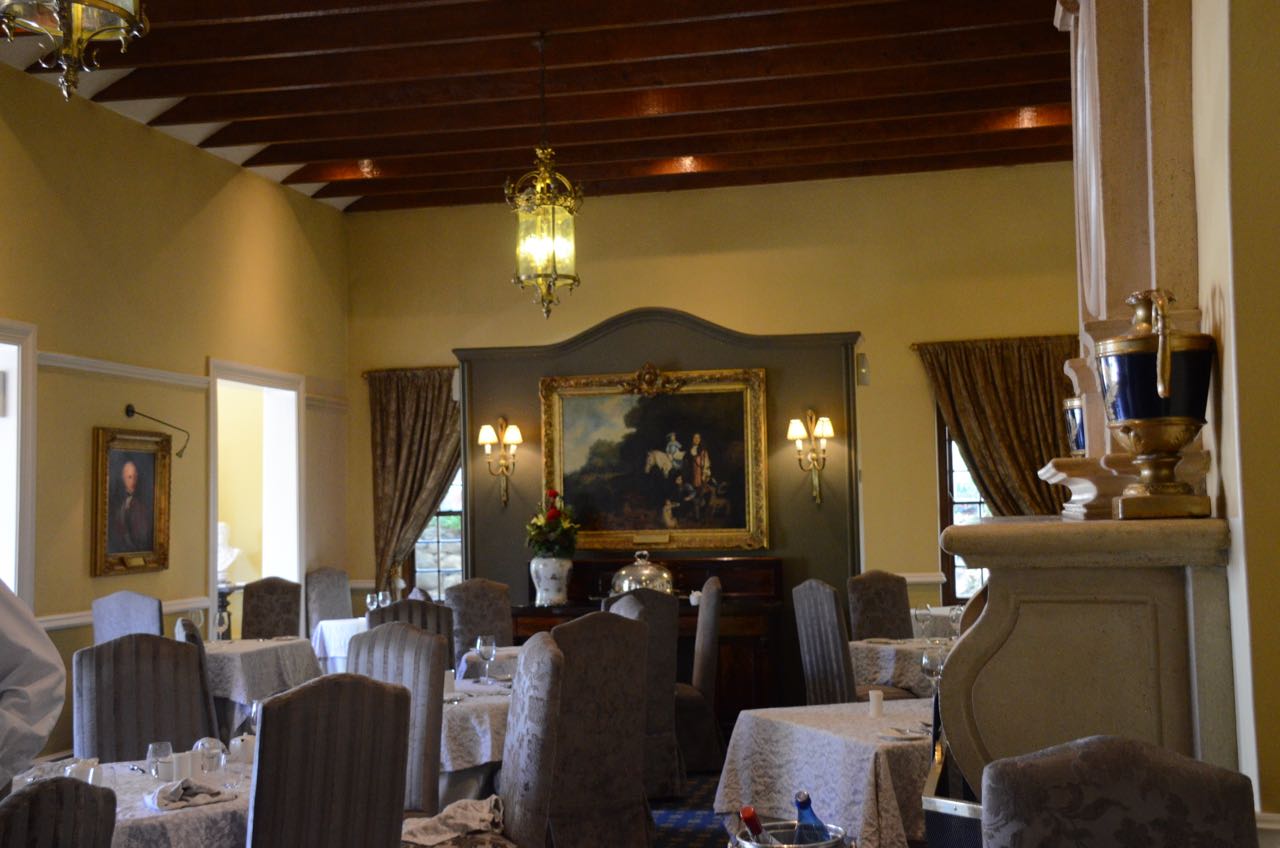
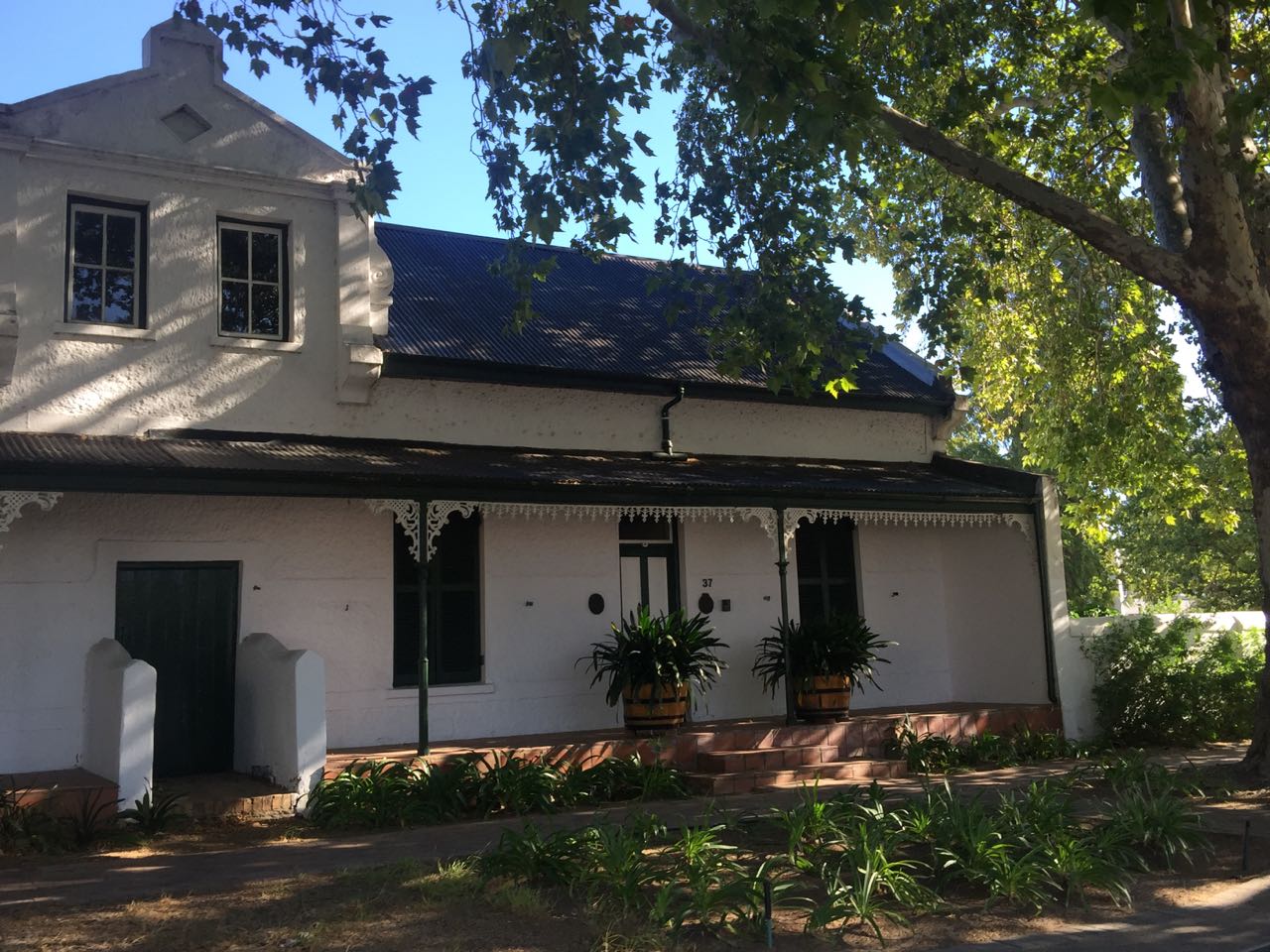
Stellenbosch – at and near the Lanzerac Hotel – still so beautiful!

DSC_2483 DSC_2484 DSC_2490 DSC_2492 DSC_2573 DSC_2580 DSC_2551 DSC_2546 DSC_2508 DSC_2502 DSC_2568 DSC_2566 DSC_2557 DSC_2528 DSC_2525 DSC_2514 DSC_2512 DSC_2532
<
>

In and around Stellenbosch

IMG_6149 IMG_6153 IMG_6154 IMG_3628 IMG_3627 IMG_3654 IMG_3651 IMG_3635 DSC_2581 DSC_2592 DSC_2598 DSC_2594 DSC_2590 DSC_2584
<
>


From the archives at the Kaplan Centre, UCT:

Stellenbosch

IMG_3408 IMG_3411 IMG_3414
<
>


IMG_3416


IMG_3417

Paarl

IMG_3494 IMG_3495 IMG_3496 IMG_3497 IMG_3498 IMG_3500 IMG_3501 IMG_3502 IMG_3503 IMG_3505 IMG_3506 IMG_3507 IMG_3510 IMG_3513 IMG_3514
<
>


Malmesbury

IMG_3515 IMG_3519 IMG_3521 IMG_3522 IMG_3523 IMG_3528 IMG_3529 IMG_3530 IMG_3532
<
>

IMG_3557

IMG_3576  IMG_5867 IMG_5866


UCT, Cape Town

IMG_3004

IMG_5877 IMG_5883 IMG_2993 IMG_2983 IMG_3012 IMG_3014 IMG_3016
<
>

Our previous visit to Stellenbosch

http://elirab.me/stellenbosch/

If you are looking for a great tour of Cape Town and / or the Boland, Gerald Potash’s “The Famous Tour” is a must!

Gerald also writes an excellent but sobering weekly blog. Contact Gerald here.

IMG_3244

With Gerald at the Waterfront.

elirab Home


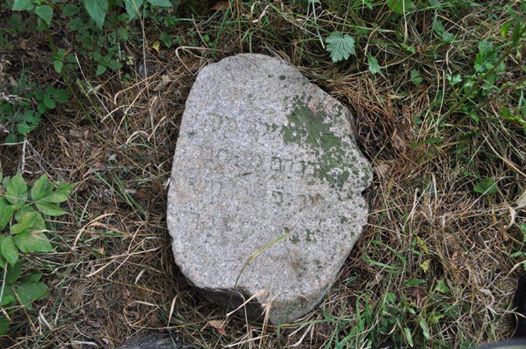
A Stone with a Story by Richard Shavei Tzion

graves-2_(308x400)

The following article was written by my wife’s cousin, Richard Shavei Tzion.

It has just appeared in Ezra magazine in Israel.

http://www.esra-magazine.com

Richard has kindly given me permission to repost it.

He writes beautifully in addition to all the other amazing talents he has – see his bio.

[iframe src=”http://www.esra-magazine.com/blog/author/Richard%20Shavei%20Tzion-706″ width=”1100″ height=”1000″]

Click on What I Call Beschert

On the subject of the Saevitzon family, below is a video of their Pesach Seder in Cape Town in 1954.

It includes the Bloch and Reitstein families.

Chag Pesach Sameach

Eli


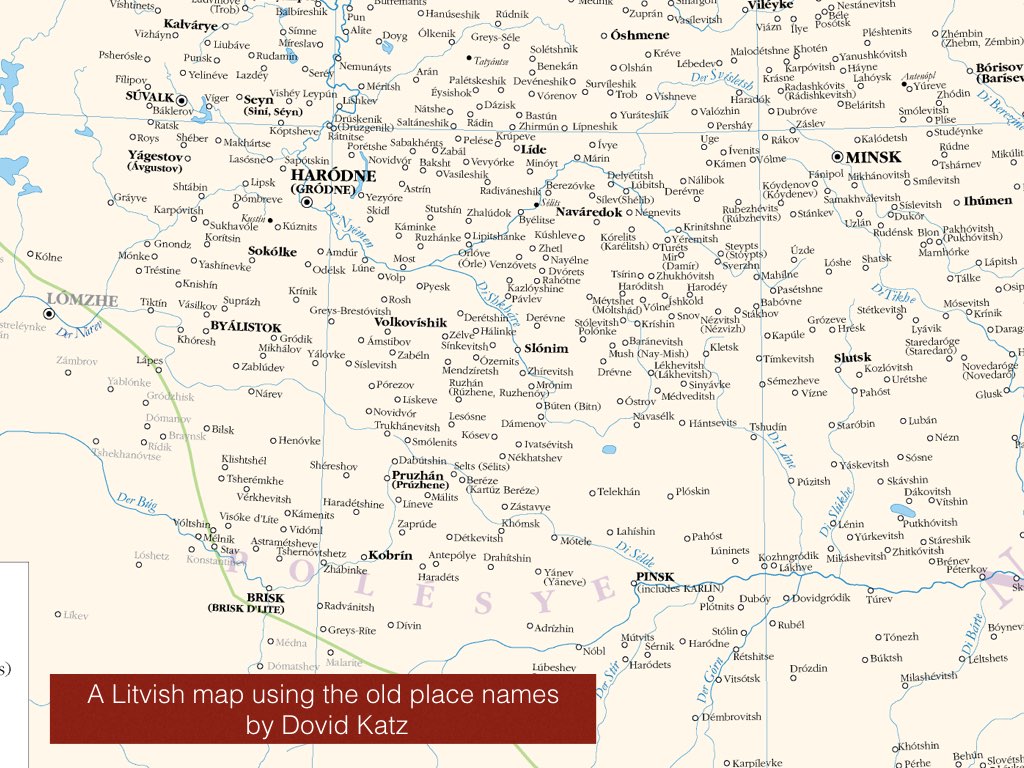
Ancestral Towns

Hi All

I am working on an ancestral town project. Please help by filling in the questionnaire below.

Thanks in advance.

Your comments are also welcome.

Chag Pesach Sameach

Eli

New Jewish Websites & Shemot

DSCN1021

In honour of the Jewish Pedlar or Smous – see Graaf Reinet KehilaLink


Screen Shot 2016-04-07 at 11.09.49 AM

Screen Shot 2016-04-07 at 11.09.36 AM

My article about the Shanghai KehilaLink has been published in the April 2016 edition of Shemot, the publication of the JGS of Great Britain.

http://www.jgsgb.org.uk/shemot

Screen Shot 2016-04-07 at 1.03.27 PM

My interest in family history started in 1992, after my cousin wrote seven ancestors’ names down on a scrap piece of paper.

I have had many genealogical success stories since then. This is due to my often unorthodox, multi focused approach, described by my daughter in law as “tangential”!

In 2011 I visited Eastern Europe for the first time. My heritage travels have taken me back four additional times. I have visited Estonia, Latvia, Lithuania, Belarus, Poland, Hungary, Germany, the Czech Republic and Turkey.

Screen Shot 2016-04-07 at 1.07.19 PM

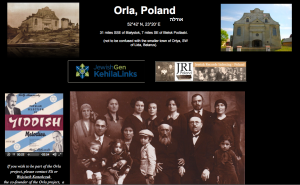
I started writing KehilaLinks in 2011, the first being for Orla, near Bialystok in Poland in 2011.

http://kehilalinks.jewishgen.org/orla

What is a KehilaLink:

JewishGen KehilaLinks (formerly “ShtetLinks”) is a project facilitating web pages commemorating the places where Jews have lived.  KehilaLinks provides the opportunity for anyone with an interest in a place to create web pages about that community.  These web pages may contain information, pictures, databases, and links to other sources providing data about that place.

Kehila קהילה [Hebrew] n. (pl. kehilot קהילות): Jewish Community.  It is used to refer to a Jewish community, anywhere in the world.

Sites are hosted by JewishGen, the world’s largest Jewish genealogical organisation, an affiliate of the Jewish Heritage Museum in New York City. JewishGen provides amateur and professional genealogists with the tools to research their Jewish family history and heritage.
People are invited to send in their own stories, photos and memoirs. There is no cost in participating in a KehilaLink and it is a great way to share one’s family history


My list has grown to 63 websites with 3 more in the pipeline.

The full list and links are available at

http://elirab.me/litvak-portal/kehilalinks/

The Shanghai KehilaLink

Screen Shot 2016-04-07 at 1.12.11 PM

http://kehilalinks.jewishgen.org/shanghai/Home.html

220px-Sugihara_b

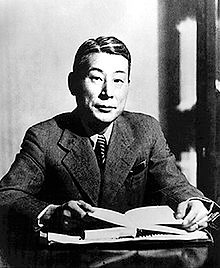
Ironically, the one place I have not been to is Shanghai! Yet, I have been drawn to it by its connection to the Jewish people and especially because of the story of Chiune Sugihara, the Japanese consul in Kovno, the capital of Lithuania during WWII. Against his government’s wishes, Sugihara issued transit visas to Jews, enabling them to get to Shanghai, and therefore saved many lives. The story only surfaced in the 1970s. See  Rabbi Levi Wolff of Sydney Central Synagogue:

http://kehilalinks.jewishgen.org/shanghai/Australia.html

The video:

Sugihara also appears on several of  my other KehilaLinks: Mir in Belarus, Kedainiai in Lithuania, and Sydney and Melbourne in Australia.

See also:

http://elirab.me/australia/sugihara-house-museum/

Four New South African KehilaLinks

This week we went live with:

Grahamstown

Graaff Reinet

Springs

Benoni

Please visit the sites. If you have connections to these towns or cities, please contact me.

There are already some interesting contributions:

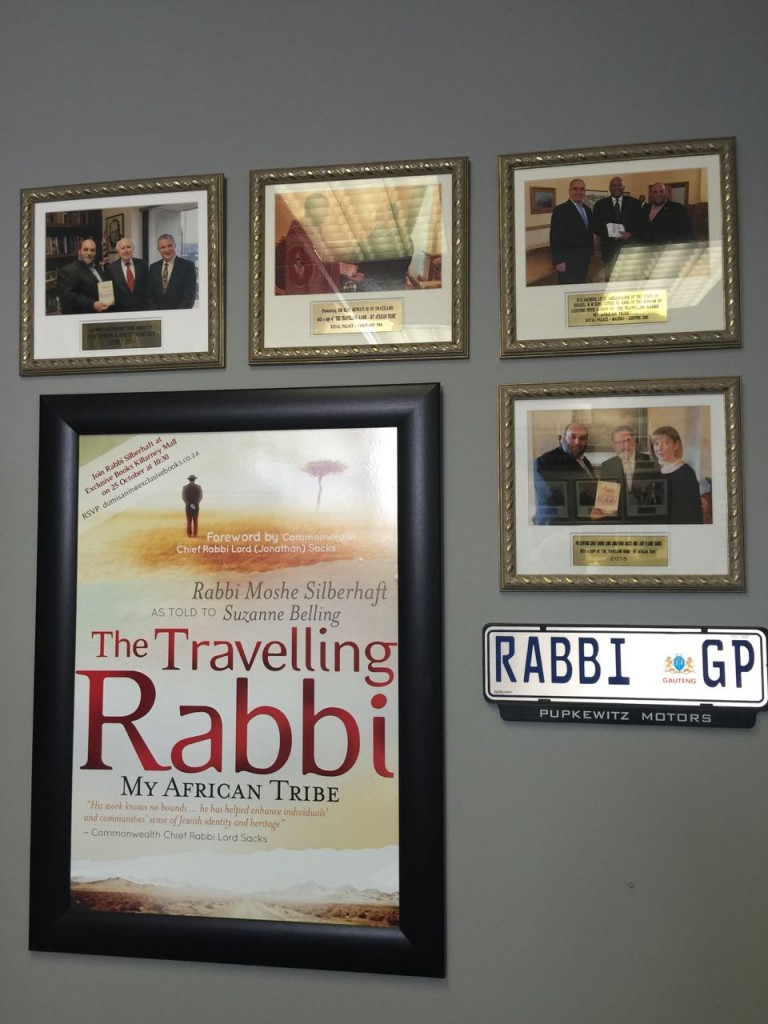
Read about the tribute to the Jewish pedlar (smous) from Rabbi Moshe Silberhaft

DSCN1021

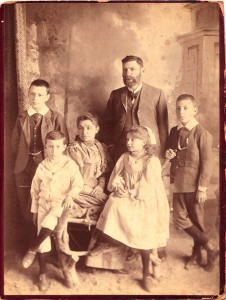
Photos of the Wertheim family from Amanda Katz Jermyn: Read Amanda’s story:

  Julius,Fritz,Mathilda,Hermann,Fanny,Max-Wertheim,-Graaff-Reinet,-abt.-1892.1

Amanda’s grandfather’s uncle, Hermann Wertheim, his wife Mathilde, and children Julius, Max, Fanny and Fritz who lived in Graaff-Reinett. It was taken in about 1892

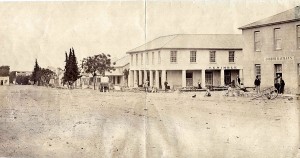
Wille-and-Wertheim-co.,right,-was-Baumann-Bros.,-Graaff-Reinet1

The general store, Wille & Wertheim, formerly Baumann Bros., where Amanda’s grandfather, August Katz came to work for his uncle Hermann Wertheim.

August Katz, Boer War

August Katz, Amanda’s grandfather, in his British Boer War uniform

048_4-s

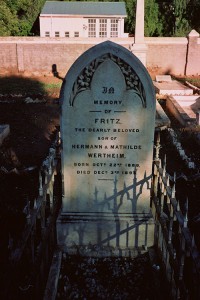
Grave of Fritz Wertheim, son of Mathilde and Hermann Wertheim. Hermann was a brother of Amanda’s great-grandmother, Mathilde Wertheim.

Kol Tuv


Digging Up Old Jewish Johannesburg

Poswohl Synagogue - Heritage Portal - September 2015 - 3
Photo by James Ball  – The Heritage Portal

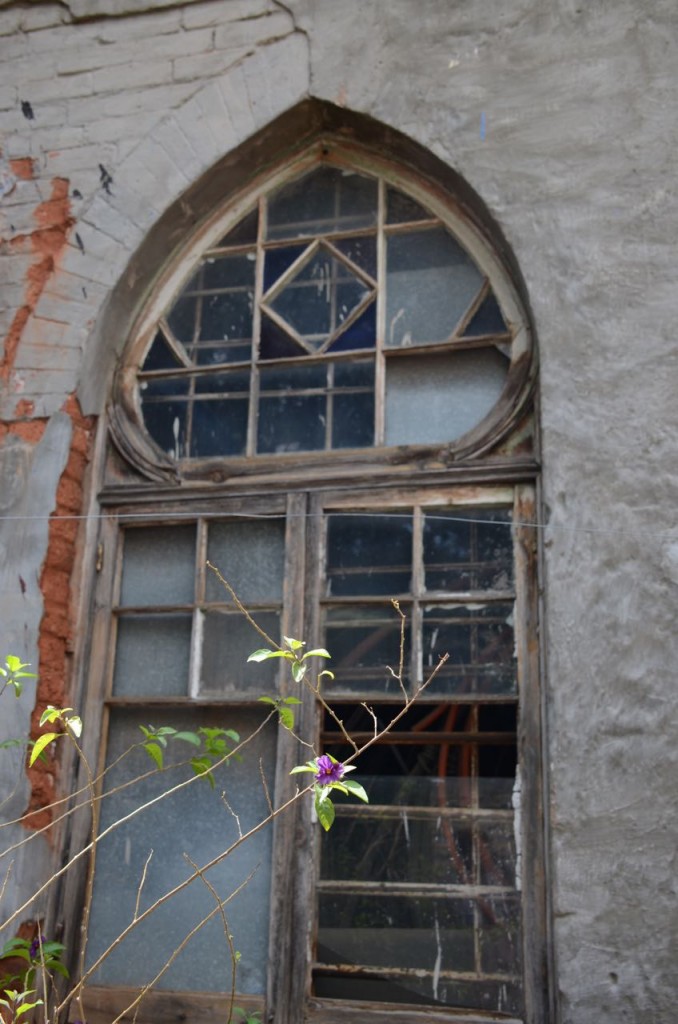
During Ishvara Dhyan’s walking tour of Doornfontein in February, he mentioned the Poswohl Shul.

DSC_1039

I did some follow up research and found some very interesting info from:

  • The Archives at Beyachad
  • Rabbi Silberhaft
  • Friends of Beit Hatfutsoth
  • James Ball’s Heritage Portal

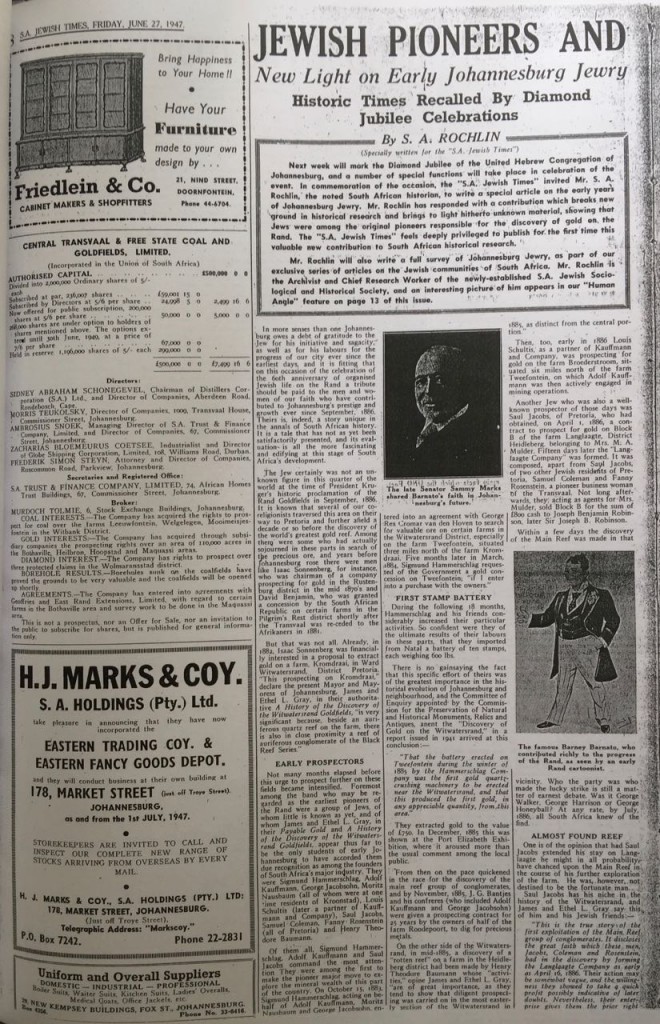
I want to thank Naomi Musiker and Rabbi Silberhaft for giving of their time and sharing information; my appreciation to Rose Norwich for allowing me to use parts of her dissertation for her Masters in  Architecture in 1988; and to Elona Steinfeld and the researchers for the next two volumes of Jewish Life in the Country Communities.

Screen Shot 2016-03-24 at 9.38.33 PM

IMG_3863


IMG_2449 IMG_2450

IMG_2448

IMG_2444

More details about the Poswohl synagogue on my Johannesburg KehilaLink website.

With permission from James Ball The Heritage Portal:

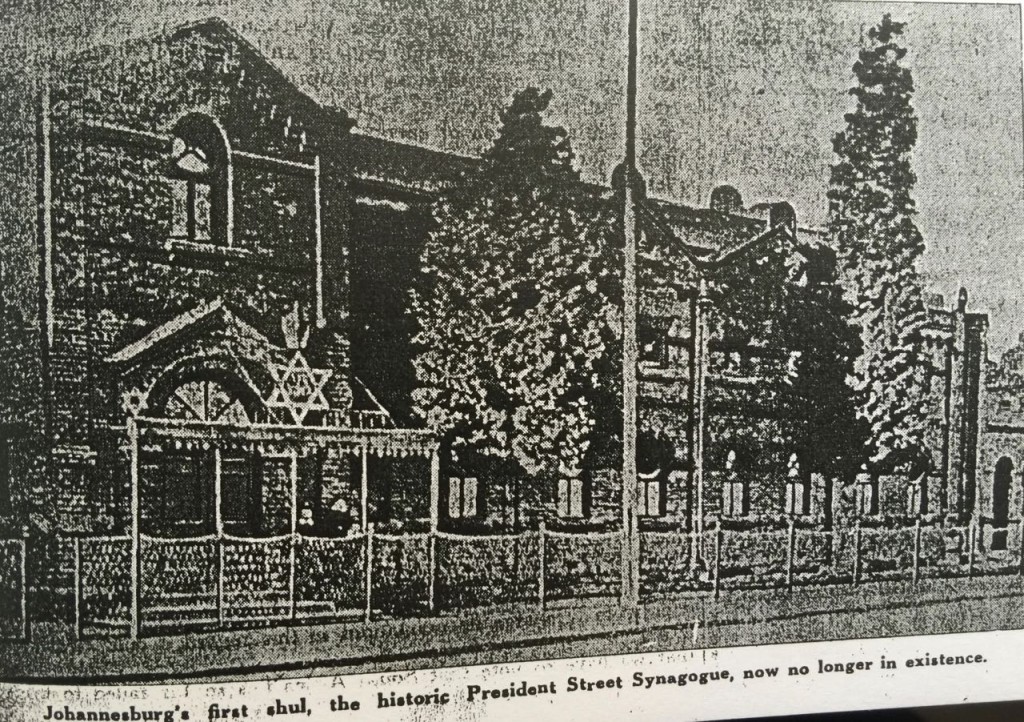
The Poswohl Synagogue – A Memorial to a Community that No Longer Exists

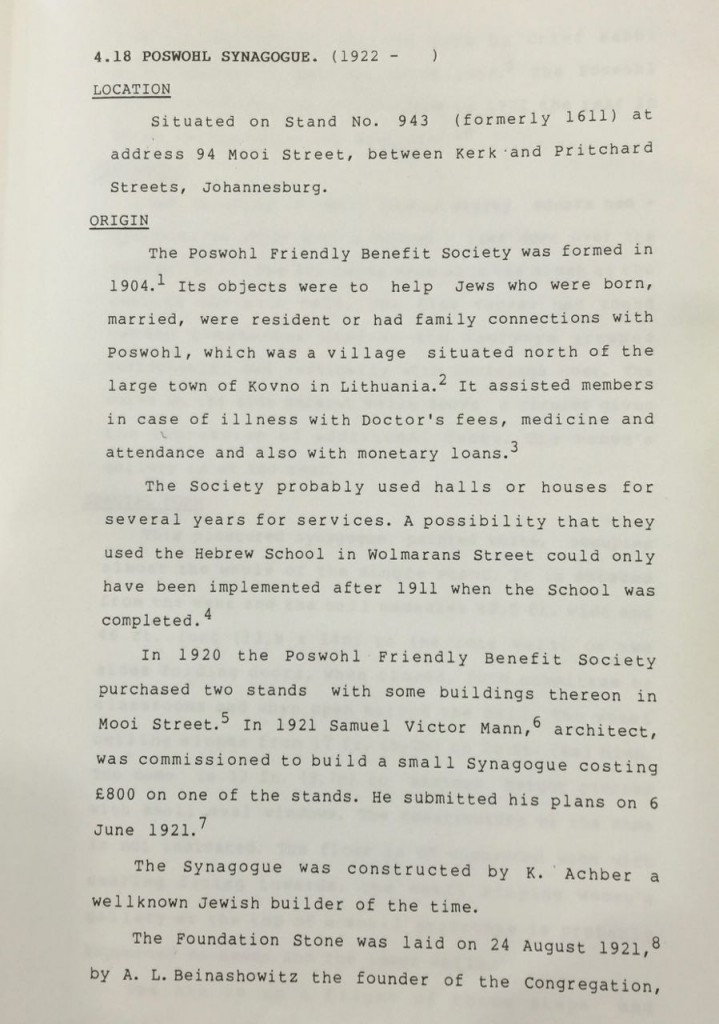
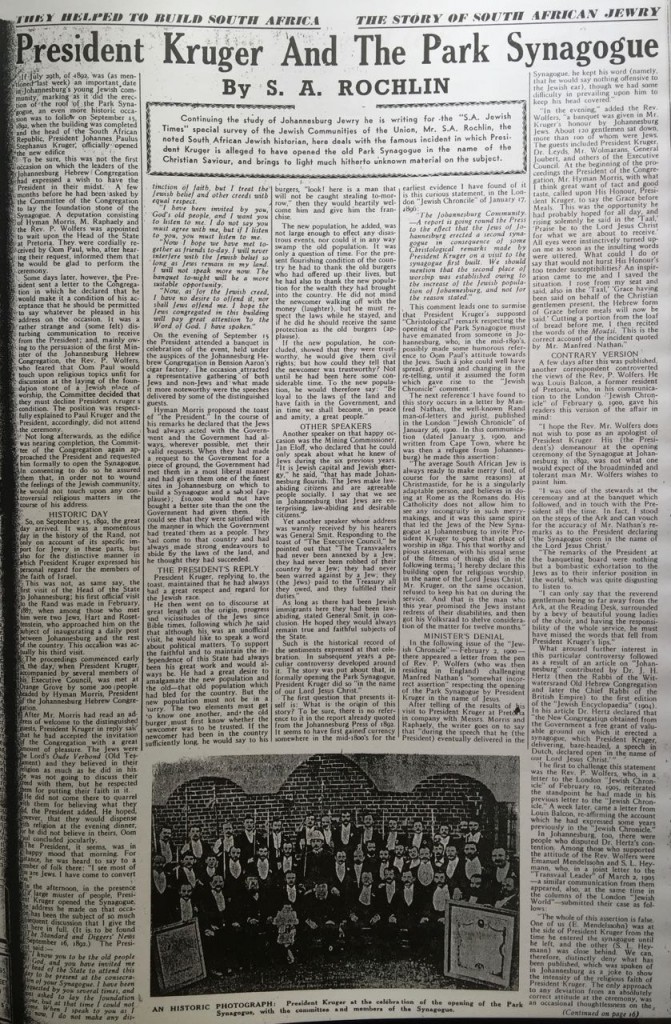
A captivating story appeared in the 1982 issue of Restorica. It was compiled by Hymie Amoils and traces the origins, history and significance of the Poswohl Synagogue in Mooi Street Johannesburg.

 In answer to Carol Hoffman’s query:

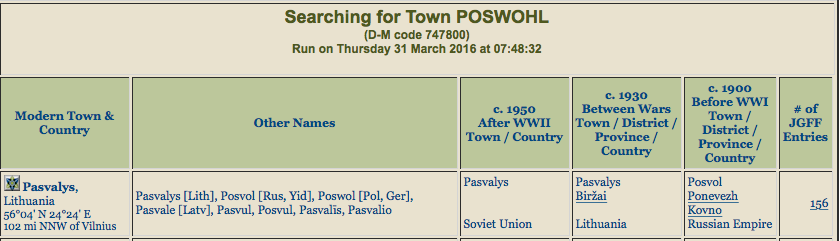
Tell me please, would this shul have been settled by Litvaks who had come from what is now known as Pasvalys?

From Rose Norwitz

Screen Shot 2016-03-31 at 9.49.52 PM

From Jewishgen.org

Screen Shot 2016-03-31 at 9.48.50 PM

With Rabbi Silberhaft

IMG_2393IMG_2389

IMG_4058

IMG_4061

IMG_4059

IMG_4060

IMG_4057

IMG_7868 IMG_7864 IMG_7873 IMG_7876 IMG_7878
<
>
IMG_7871 IMG_7872 IMG_7875 IMG_7879 IMG_7881
<
>

IMG_7860

IMG_2647

[iframe src=”http://kehilalinks.jewishgen.org/johannesburg/Poswohl.html” width=”100%” height=”800″]

Jewish Doornfontein – Part 4

We continue on Ishvara Dhyan’s walking tour of Doornfontein

Beit Street

DSC_1403

Beit Street For many generations immigrant Jews would make their way to Beit Street, a supportive Jewish enclave in Doornfontein. Beit Street used to be the commercial hub of the suburb, crowded with kosher butcheries, shoemakers, tailors, blacksmiths, carpenters and barbers, interrupted by bicycles, horses and carts or trams making their way down the middle of the street. Hawkers and pedlars crowded the pavements, with live chickens, eggs, ice and coal on sale. (City of Johannesburg – Jews mark 120 years)

DSC_1041 DSC_1473 DSC_1042 DSC_1063 DSC_1066 DSC_1060 DSC_1476 DSC_1471
<
>

From Wikipedia, the free encyclopedia

History of the Jews in South Africa

From Union through World War II

Although the Jews were allowed equal rights after the Boer War, they again became subject to persecution in the days leading up to World War II. In 1930, the Quota Actof 1930 was intended to curtail the entry of Jews into South Africa. The vast majority of Jews immigrating to South Africa came from diaspora communities in Lithuania. The 1937 The Aliens Act, motivated by a sharp increase the previous year in the number of German Jewish refugees coming to South Africa, brought the migration to almost a complete halt. Some Jews were able to enter the country, but many were unable to do so. A total of approximately six-and-a-half thousand Jews came to South Africa from Germany between the years 1933 and 1939.[12] Many Afrikaners (i.e., Boers) felt sympathy for Nazi Germany, and organizations like Louis Weichardt’s “Grayshirts” and the pro-Nazi Ossewabrandwag were openly anti-Semitic. During World War I, many Afrikaners, who had little respect for Britain, objected to the use of “Afrikaner women and children from the British concentration camps” in fighting the German territory of South West Africa on behalf of Britain. This had the effect of drumming up pro-German sentiment among a population of Afrikaners. The opposition National Party argued that the Aliens Act was too lenient and advocated a complete ban on Jewish immigration, a halt in the naturalization of Jewish permanent residents of South Africa and the banning of Jews from certain professions.[13] After the war, the situation began to improve, and a large number of South African Jews, generally a fairly Zionist community,[6] made aliyah to Israel. While it is understandable that many South African Jews would feel uncomfortable with formerly pro-Nazi Afrikaners rising to power in 1948, many leading apartheid-era Afrikaner politicians publicly apologized to the South African Jewish community for their earlier anti-semitic actions and assured it of its continued safety in South Africa.

During this time, there were also two waves of Jewish immigration to Africa from the island of Rhodes, first in the 1900s and then after 1960.[14][15]

The German Jewish Refugees – Elfreda Court


DSC_1401 DSC_1406 DSC_1437 DSC_1404 DSC_1407 DSC_1438
<
>

The Jewish Government School

Education Several Jewish schools were built, and one, the Jewish Government School, now the IH Harris Primary School in Davies Street, Doornfontein, still goes strong. Yiddish used to be the only language heard in the playground. (City of Johannesburg – Jews mark 120 years)

DSC_1436 DSC_1409 DSC_1412 DSC_1418 DSC_1433 DSC_1426
<
>
DSC_1420 DSC_1424 DSC_1425 DSC_1427 DSC_1428 DSC_1434
<
>

The Ottoman Consulate

DSC_1446 DSC_1444 DSC_1447 DSC_1449 DSC_1460 DSC_1466
<
>
DSC_1448 DSC_1451 DSC_1458 DSC_1459 DSC_1464
<
>

From Ishvara

Screen Shot 2016-03-24 at 8.35.38 AM

The Seven Synagogues of Doornfontein :

* Great Synagogue ( Wolmeraans St ) 1914
* Lion Shul ( Harrow Rd ) 1905
* Beit Hamedrash HaGodel ( Sherwell St ) 1931
* Altesheim Shul ( Louisa St ) 1927
* Chassidishe Shul ( Siemert St ) 1930
* Ponevez Shul ( Hilner St ) 1931
* Poswohl Shul ( Mooi St ) 1921


The Beth Hamedrash HaGodel is where famous Latvian Cantor Berele Chagy sang 1932 – 1941

Greeks in South Africa

From Wikipedia, the free encyclopedia
 The Greek community in South Africa numbers about 13,000 people, according to the US Library of Congress.[1]
Notable people

Johannesburg’s first Greek Orthodox Church 1913

DSC_1359 DSC_1363 DSC_1364 DSC_1370 DSC_1372 DSC_1386 DSC_1388 DSC_1389 DSC_1395
<
>
DSC_1367 DSC_1371 DSC_1382 DSC_1394
<
>

Marc Latilla’s excellent work on the old suburbs of Johannesburg.

[iframe src=”https://johannesburg1912.wordpress.com/” width=”100%” height=”800″]

https://johannesburg1912.wordpress.com

Return To Nasielsk

Nasielsk

From: Glenn Kurtz

Dear Friends of Nasielsk!

I am very pleased to announce that the restoration and rededication of Nasielsk’s Jewish cemetery will take place this summer, from 3 – 8 July 2016.

You are invited to participate! Volunteers are welcome for all or any part of the project: a day, a few days, or the entire week.

As those of you who have visited Nasielsk know, the former Jewish cemetery is now a mature forest, overgrown and unkempt. Since no (or very few) headstones remain, our work this summer will be to clear the brush and the forest floor. We expect it will be a multi-year project. Once we have cleared the ground, we can discuss and decide on a memorial and a preservation plan.

We are fortunate and grateful to be partnering with the Foundation for the Preservation of Jewish Heritage in Poland (FODŻ), based in Warsaw, and the Matzevah Foundation, based in Atlanta. FODŻ, which has helped restore cemeteries and synagogues throughout Poland, will manage the legal and community relations aspects of the project, while the Matzevah Foundation will help with logistics and labor.

Each participant will be responsible for independent transportation to Warsaw. The Matzevah Foundation will collect a $300 fee to defray administrative and material expenses. Details regarding lodging, local transportation, etc., will be forthcoming in late April.

Our project has the support of Mayor Ruszkowski of Nasielsk and of the local community. We anticipate that high school students and other local volunteers will join us to assist with the clean up. Under the auspices of the cemetery project, we will have the opportunity to share the importance of Jewish history with local community members. As always, we hope our presence will encourage the local community to preserve the memory of Nasielsk’s Jewish history and to incorporate it into the school curriculum.

Finally, during our stay we may be privileged to participate in a ceremony honoring Helena Jagodzińska, sponsored by Yad Vashem and held at the new POLIN Museum of the History of Polish Jews in Warsaw. Helena helped Nasielsker Maurice Chandler to survive the war and was named a Righteous Gentile in January 2016. Her family (who accompanied us to the Polin Museum in October 2014) will receive the official commendation.

Please contact me or Michael Valihora with any questions or if you would like to participate.

We hope you will join us!

Glenn

Visit the Nasielsk KehilaLink

Jewish Doornfontein – Part 3

DSC_1332

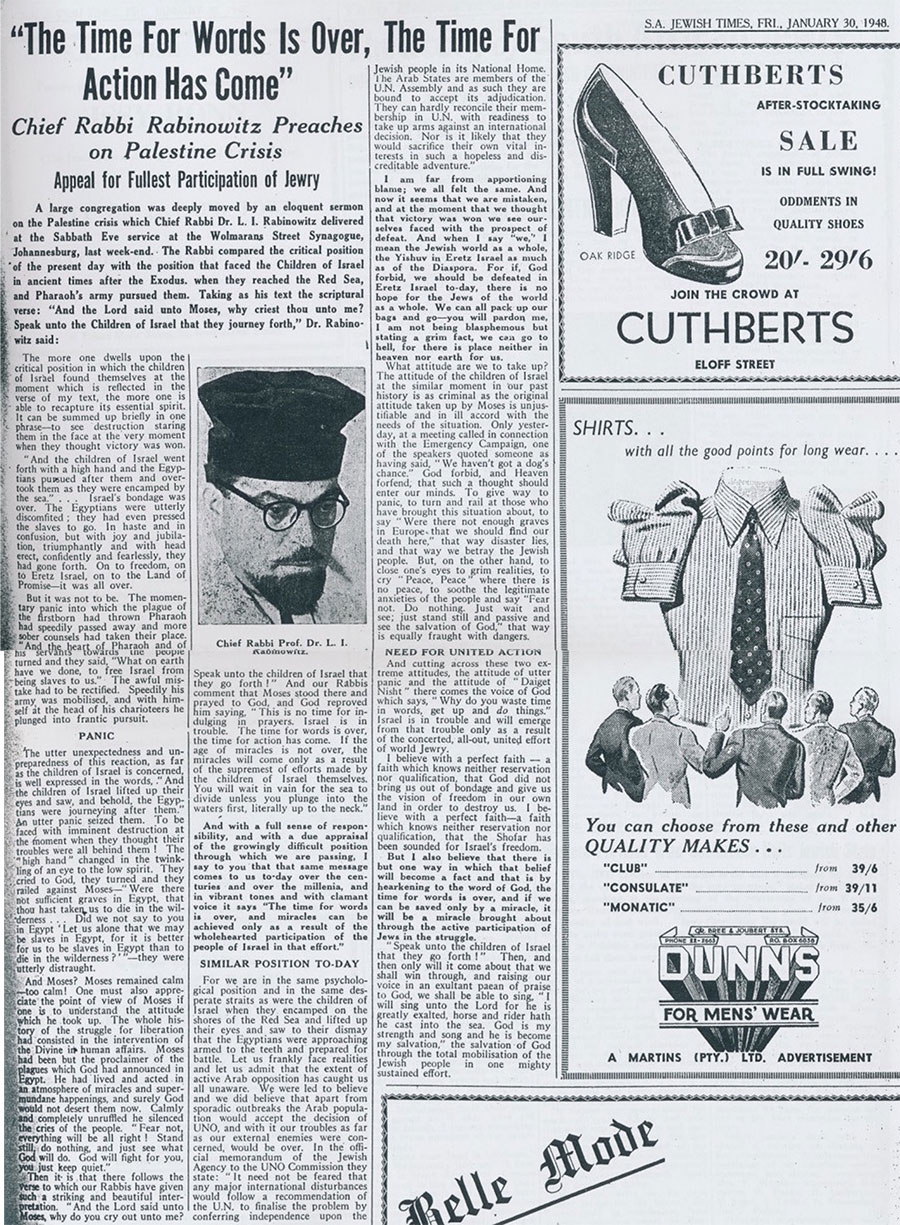
From the past when it was the Great Synagogue:

Louis-Rabinowitz

My thanks to Rabbi Moshe Silberhaft for giving me the book he compiled which included the above article.

IMG_4058


93px-Louis_Rabinowitz

A sound clip of Chief Rabbi Louis Rabinowitz, showing his style of oratory. It was part of the toast he made to our Rabinowitz family at my sister, Sorrel Rabinowitz and Gidon (Clive) Katz’s wedding in 1961. Here is the Chief Rabbi making the point that we were not related, and so aren’t most Rabinowitzes!
[sc_embed_player fileurl=”http://elirab.me/wp-content/uploads/2016/03/Chief-Rabbi-Louis-Rabinowitz-1961-Short.mp3″]

Louis Rabinowitz 1

The book about Rabbi L I Rabinowitz written by my late cousin, Rabbi Gerald Mazabow z”l

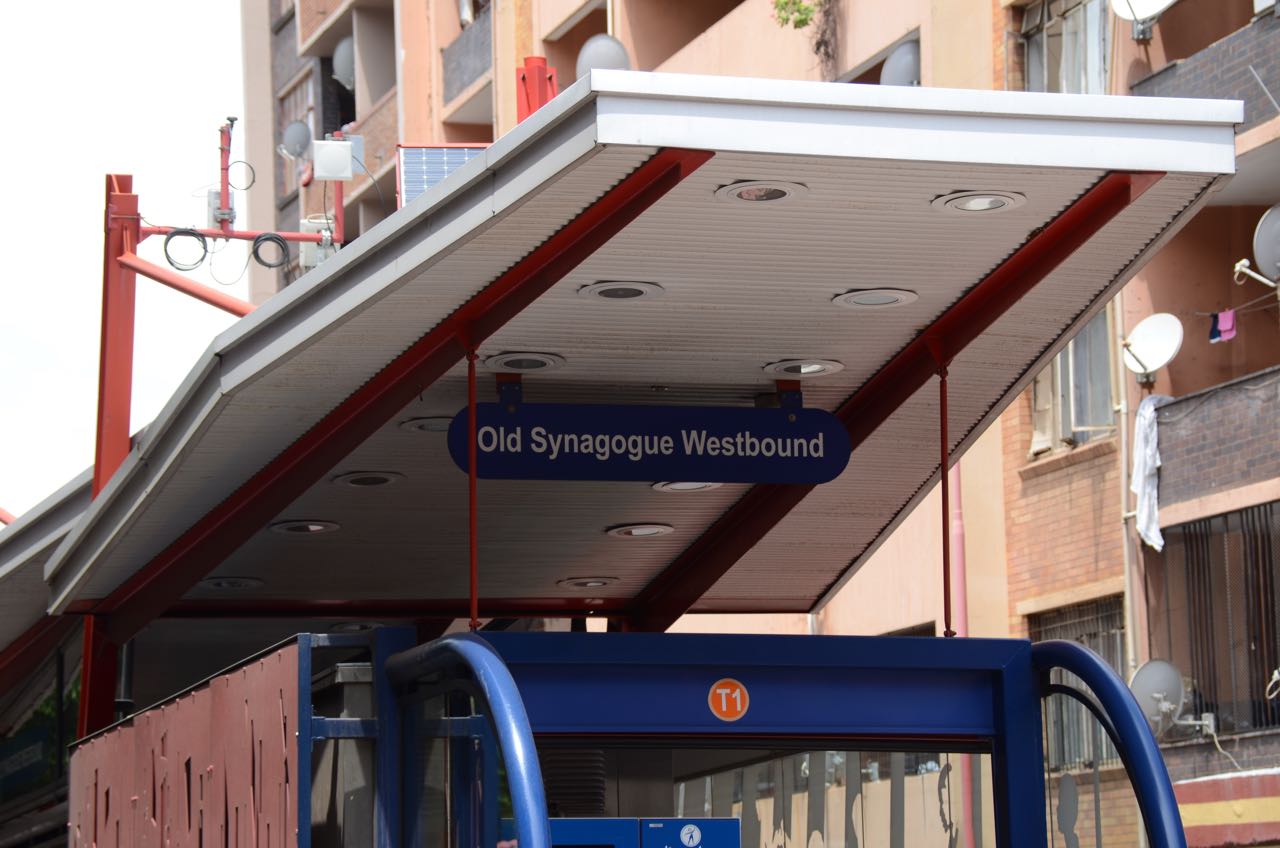
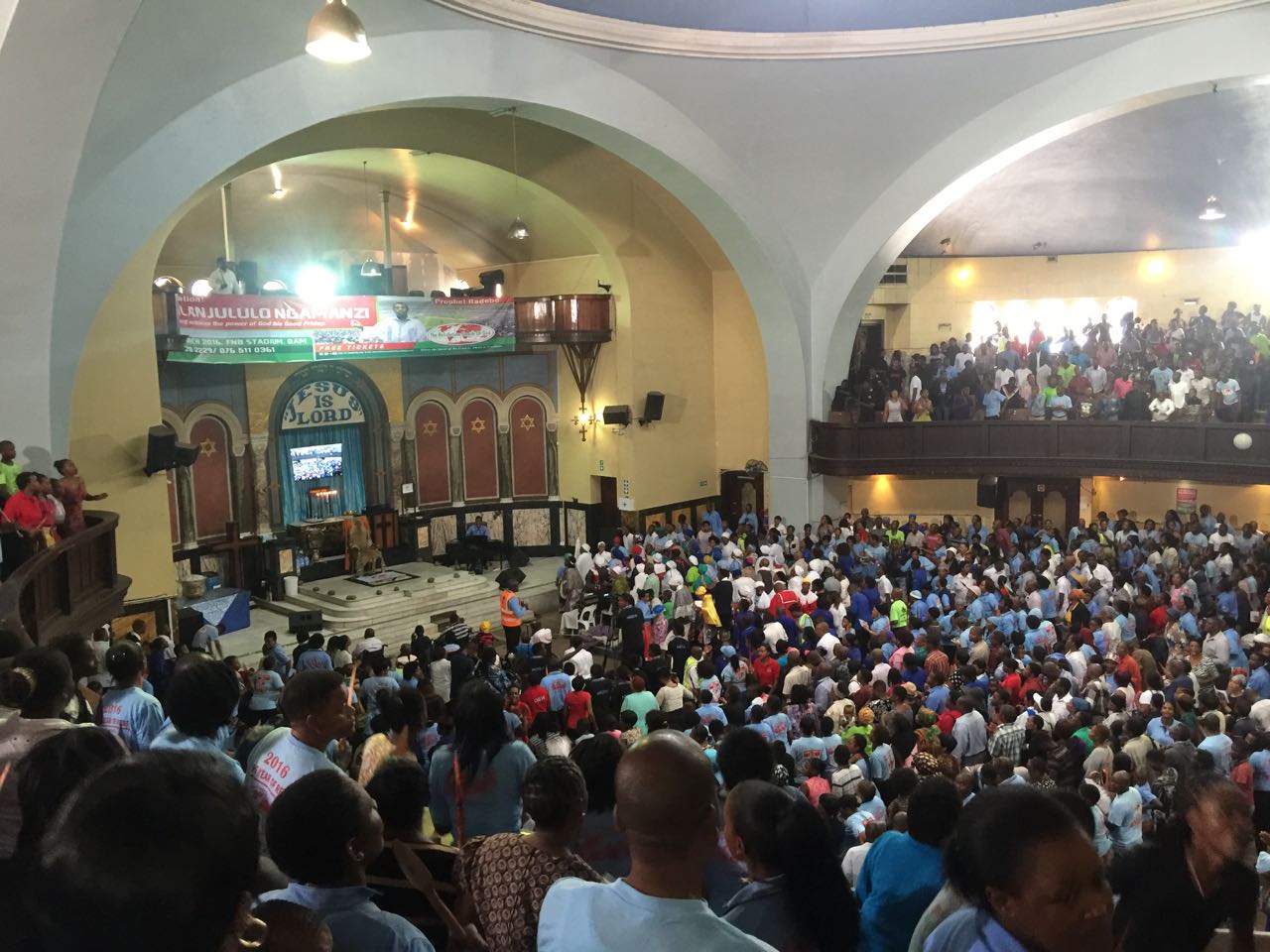
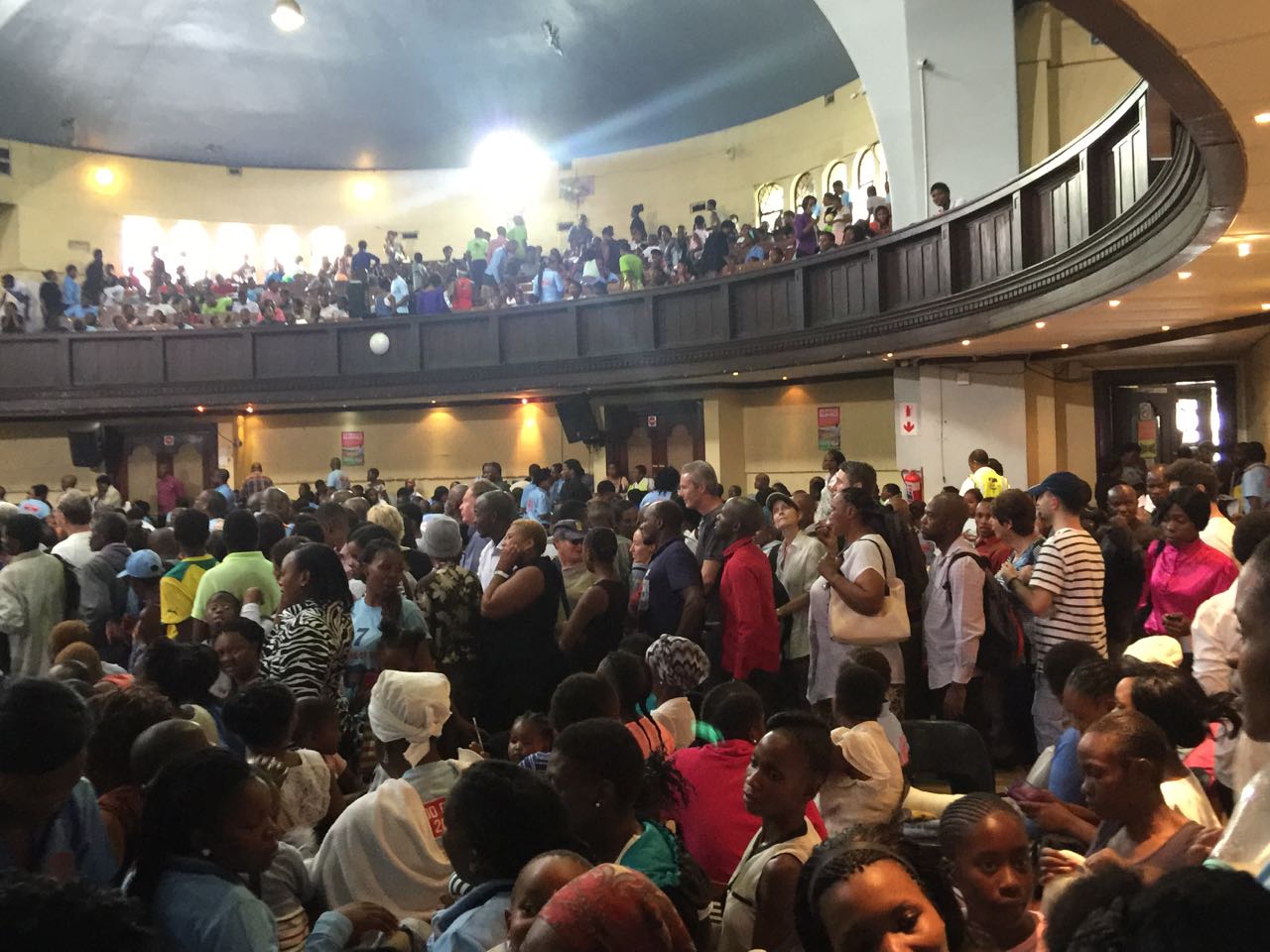
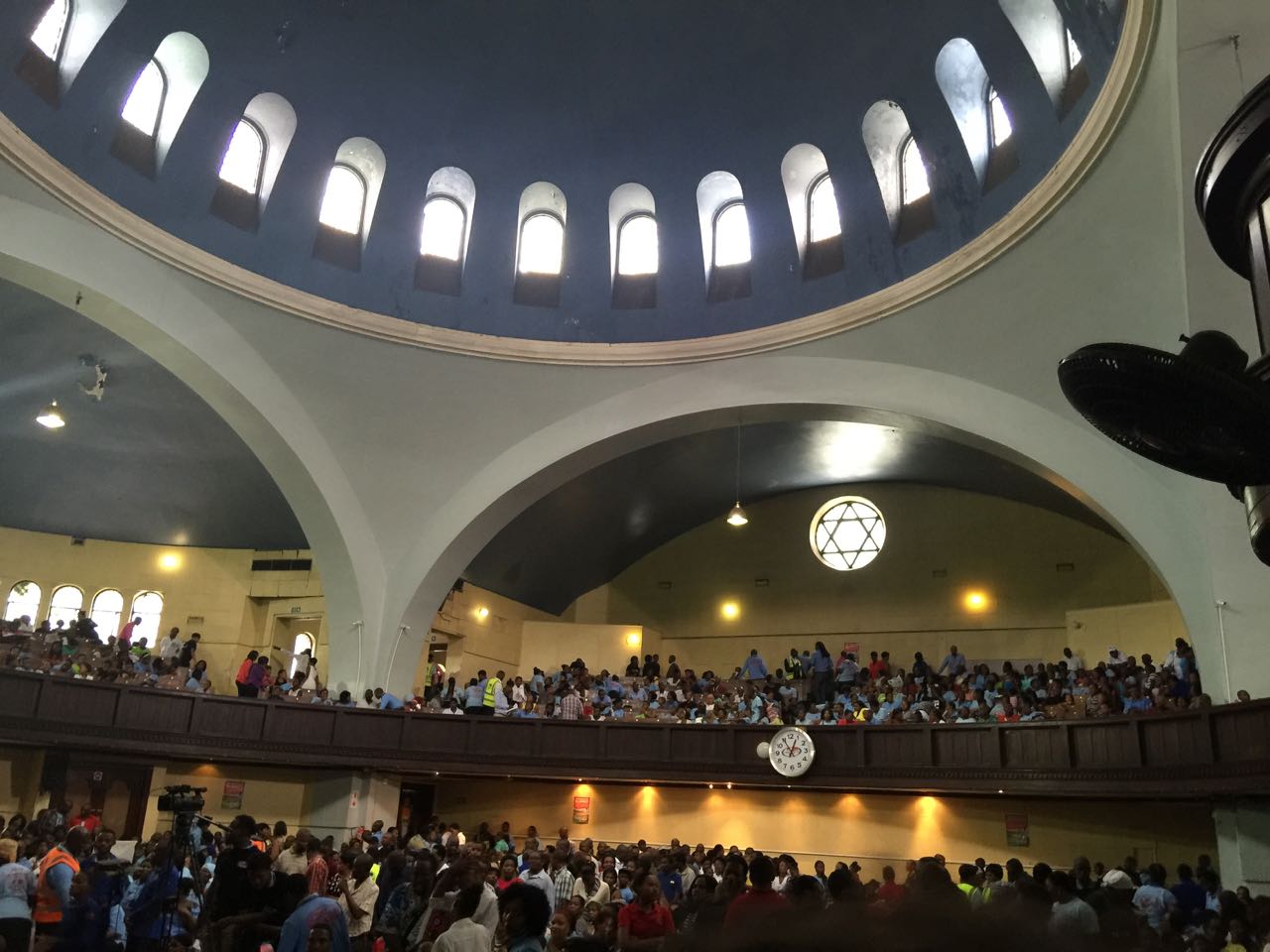
The Great Synagogue, Wolmarans Street is today The Revelation Church of God.

Revelation-Church

We continue on Ishvara Dhyan’s Walking Tour of Doornfontein;

On the outside:

DSC_1350 DSC_1351 DSC_1356 DSC_1354 DSC_1318 DSC_1319 DSC_1321 DSC_1322 DSC_1324 DSC_1326 DSC_1329 DSC_1331 DSC_1332 DSC_1333 DSC_1335 DSC_1341 DSC_1345 DSC_1314
<
>

The scenes inside

IMG_2211 IMG_2270 IMG_2229 IMG_2220
<
>

IMG_2199 IMG_2267 IMG_2246 IMG_2215 IMG_2218 IMG_2230 IMG_2231 IMG_2234 IMG_2235 IMG_2237 IMG_2243 IMG_2239
<
>

Some video footage of the remarkable scenes around and inside the building:


Goldenbergs


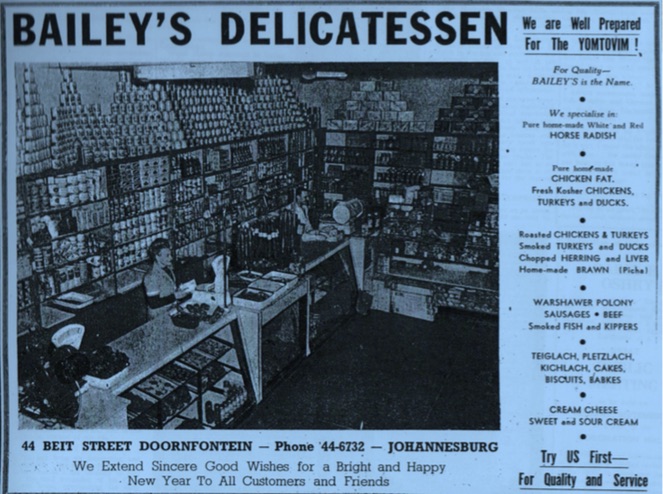
Baileys


Marc Latilla’s excellent work on the old suburbs of Johannesburg.

[iframe src=”https://johannesburg1912.wordpress.com/” width=”100%” height=”800″]

https://johannesburg1912.wordpress.com

Back