Update from David Sandler

From David:

As mentioned before I’m currently working on reprinting in English  

-SOUTH AFRICAN LANDMANSCHAFT (Sick and Benefit Societies) books where the societies in Johannesburg remember the towns in Lithuania where they came from:


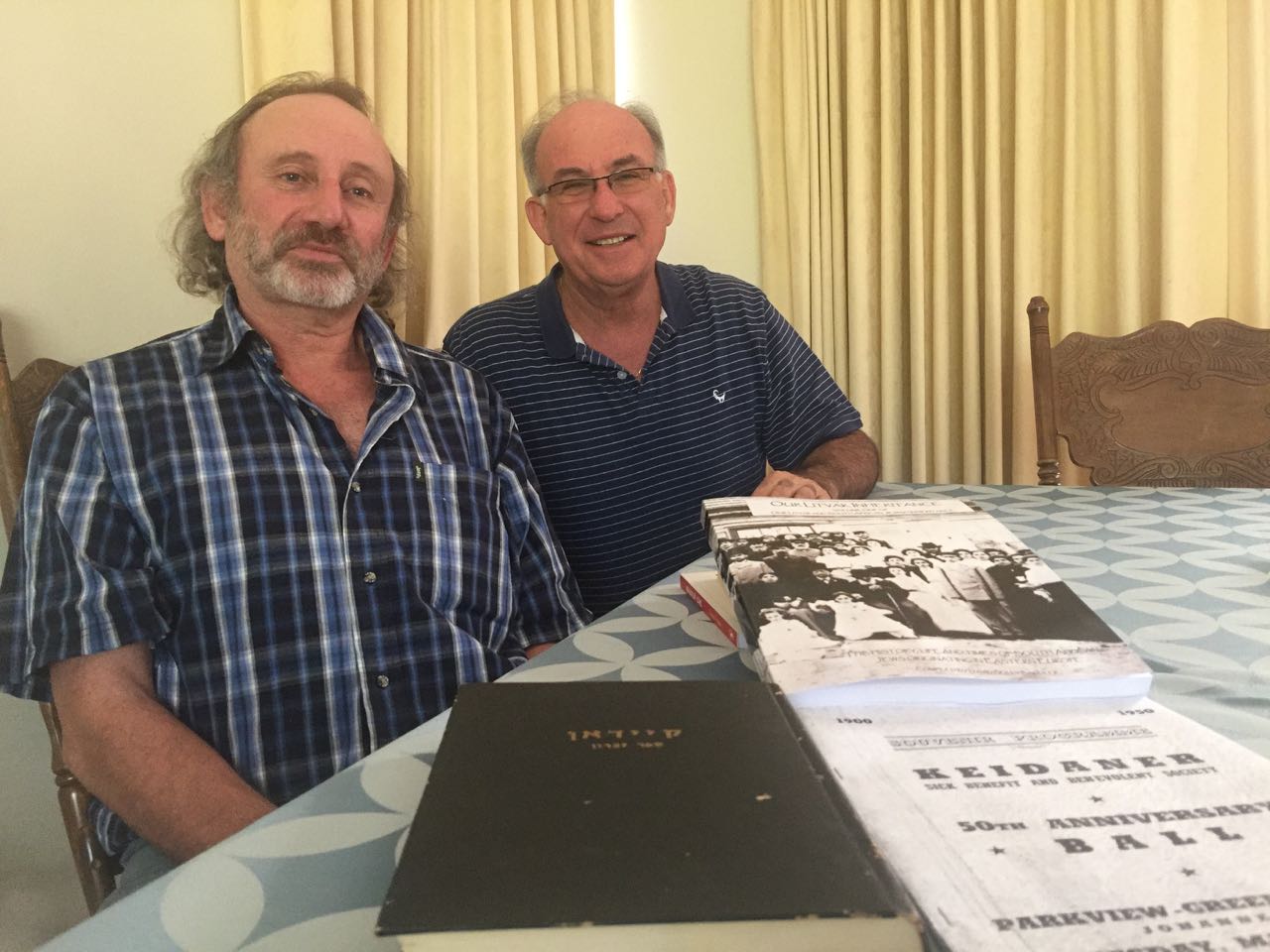
I also share with you covers of the Keidan and Krakenowo, the booklets completed so far. Bella Golubchik has translated the Hebrew and Yiddish articles into English.


Keidaner Sick, Benefit and Benevolent Society 50th Anniversary Souvenir Programme that I completed a week ago. 

This book, Keidan, Our Town In Lithuania, commences with the Jewish history and life in Keidan and then focuses on the destruction of Jewish life in 1941 with the arrival of the Germans. It then focuses on the South African Keidaner Sick Benefit and Benevolent Society.


The book, is an adaptation of the 50th Anniversary Souvenir Programme of the South African Keidaner Sick Benefit and Benevolent Society. While it includes all the contents of the Souvenir Programme, the order has been rearranged. 


With the permission of Aryeh Shcherbakov and Andrew Cassel of the Israeli and Keidan Societies several articles, translations and photos from the Keidan Yizkor Book have been included for completeness.


A large proportion of the Souvenir Programme, was written in Yiddish and has now been translated into English thanks to Bella Golubchik, Aryeh Shcherbakov and Andrew Cassel. 


KRAKENOWO ~ A TOWN IN LITHUANIA ~ the story of a world that has passed completed some month a ago


I’ve obtained scans of the original Ponevez and the Malater booklets and PG we will translate the articles in Yiddish to English and eventually reprint the booklets all in English.


-SOUTH AFRICAN YIZKOR BOOKS


There are two Yizkor books connected to South Africa and PG will be published in English soon

The Yizkor Book of Rakishok and environs published in 1952 in SA in Yiddish

-The Keidan Yizkor Book. published in 1977 in Hebrew by the US Israeli and South African Keidan Associations.

Another Yizkor book originating in South Africa is Yizkor book on Chelm – originally published in 1954 in Yiddish in South Africa. The book has been partly translated by Jewish Gen. I offered to help them with the articles that have not been translated but they refused my help and I’m thinking how to proceed. 


If you know of any other book or booklets from Landmanschafts in South Africa please let me know!

THE OCHBERG ORPHANS – volume two has 82 chapters and 361 pages and is priced at US$50 (Rand 750). The first volume costs US$80 (Rand1200)  and the set (volumes one and two) are on sale for US$100 (Rand1500). To buy books email me your address and please make appropriate donation direct to Arcadia online using your credit card and paying in Rands and use Chev Acc no: 41997.      https://www.jhbchev.co.za/pages/OnceOffDonation.aspx


SOUTH AFRICA’S 800 – the Story of South African Volunteers in Israel’s War of Birth in 1948/9

At the request of Joe Woolf, the editor of the book, I have set the book up for very easy reprinting 

Shalom, best wishes and good health to you and your family 

David

David Solly Sandler sedsand@iinet.net.au


BOOKS COMPILED BY DAVID SOLLY SANDLER

100 Years of Arc Memories published 2006 

The Arcadia Centenary book contains the memories of over 120 children of The South African Jewish Orphanage.

More Arc Memories published 2008

A follow-up of the Centenary book with the memories of more than 100 children. ( This book includes a section of 17 chapters on the Ochberg Orphans.)

The Ochberg Orphans and the Horrors From Whence They Came published 2011

The rescue in 1921 of 181 Ukrainian War and Pogrom Orphans by Isaac Ochberg, the representative of the South African Jewish Community, from the horrors of the Pale of Settlement.

The Pinsker Orphans published 2013

The Pinsker Orphans book – in part a follow up of  The Ochberg Orphans book – tells of the life and times of the children from the three Pinsk Jewish Orphanages in the 1920s and like The Ochberg Orphans book is but a small part of a much larger and forgotten part of Jewish History, the horrors suffered by the Jews in The Pale of Settlement between the two world wars. 

This Was a Man Reprinted 2014

This book is the life story of Isaac Ochberg as written by his daughter Bertha Epstein and first published in 1974.

Reprinted with the permission of the family of Isaac Ochberg z”l with an addendum added.

Memories of Oranjia, The Cape Jewish Orphanage (1911-2011) published 2014

The book is a collection of the memories of many generations of children (over 120) who were in the care of The Cape Jewish Orphanage which was established in 1911 in Cape Town South Africa.

The Memorial Section of the  Rakishok Memorial Book

This book was originally published in 1952 in Yiddish by the Rakishok Landmanschaft in Johannesburg. The book has been translated into English by Bella Golubchik and is for sale with all proceeds going to Arcadia Oranjia and the JDC. 

Our Litvak Inheritance published March 2016

This book tells of Jewish history, life and times in Lithuania and surrounds – the inheritance of most South African Jews and is the matching volume to Our South African Jewish Inheritance.

Our South African Jewish Inheritance published August 2016

This book tells of Jewish history, life and times in South Africa and is compiled from numerous articles, books and family histories.

South Africa’s 800 The Story of South African Volunteers (Machalnics) In Israel’s War of Birth  by Henry Katzew

Reprinted with the permission of Joe Woolf in August  2016

The Ochberg Orphans – volume two- published 2017 

A follow up from the first book that includes more of the stories of the Ukrainian Orphans, details of the Pinsk Orphanages and children going to South Africa and rescued by the Pinsker Orphan Relief Fund of London and modern ceremonies, books and documentaries to remember Isaac Ochberg. 

Krakenowo ~ a town in Lithuania ~ the story of a world that has passed – published 2017

The reprint of the booklet printed by the South African Krakenowo Sick Benefit and Benevolent Society in 1961 to celebrate its diamond Jubilee. All articles in Yiddish have now been translated into English.

Keidan – our town in Lithuania – published 2017

An adaptation of the 50th Anniversary Souvenir Programme of the South African Keidaner Sick Benefit and Benevolent Society. It commences with the Jewish history and life in Keidan then tells of the destruction of Jewish life in 1941. The book then focuses on the South African Keidaner Sick Benefit and Benevolent Society.


Please contact me to order your book – David Solly Sandler sedsand@iinet.net.au

All proceeds go to Arcadia Oranjia or the JDC


Stan The Good Shabbos Man

Stan TGSM – Home

Stan TGSM – Home

Source: stantgsm.com

With Lionel Slier

Taken at my talk at the Great Park Synagogue earlier this year.

Lionel Slier’s article

REMEMBERING ISAAC OCHBERG, FATHER OF ORPHANS

appeared in the Jerusalem Post and is on the Brest KehilaLink:

kehilalinks.jewishgen.org/brest/Ochberg.html

Brest, Belarus

L-R Zinky Agulnik, Kfar Saba (ex SA); Susan Jacobson, Cape Town; Jack Slier, Shanghai; Hayley Slier, London; Lionel Slier, Johannesburg; Paula Slier, Modi’in; Tanya Jacobson, Cape Town; Phillipa Jacobson, Baltimore; Leanne Jacobson, Amsterdam; Daniel Goldfine, Tel Aviv; Alicia Slier, Johannesburg

The Brest KehilaLink homepage:

Brest, Belarus

My Talks at the Great Park & Gardens Shuls

Understand The Poem

The Partisan Poem – Zog Nit Keynmol

Use this site to translate the poem into 104 languages.

  • Click on the “Translate” button on the bottom right of your screen to start.
  • Select a language and it is translated in a few seconds!
  • Be inspired

The Partisan Poem – Zog Nit Keynmol

Never say this is the end of the road.

Wherever a drop of our blood falls, our courage will grow anew.

Our triumph will come and our resounding footsteps will proclaim: We are here!

From the land of palm trees to the far off land of snow,

We shall be coming with our torment and our woe.

And everywhere our blood has sunk into the earth, our bravery and vigor will blossom forth!

We’ll have the morning sun to set our days aglow.

Our evil yesterdays will vanish with the foe.

But if time is long before the sun appears, let this song go like a signal through the years.

This song was written with our blood and not with lead.

It’s not a song that summer birds sing overhead.

It was a people amidst burning barricades that sang the song of ours with pistols and grenades.

So never say you go on your last way.

Though darkened skies may now conceal the blue of the day.

Because the hour for which we hungered is so near.

Beneath our feet the earth shall thunder: We are here!

Hear the poem recited in English and in Lithuanian

The Poem

The Partisan Poem  was written as a poem of hope, heroes and spirited resistance by Hirsh Glik,  aged 20, in the Vilna ghetto in 1943. Aaron Kremer’s English version recited by Freydl Mrocki, a teacher at Shalom Aleichem College in Melbourne and in Lithuanian by student Giedrius Galvanauskas of the Atzalynas Gymnasium in Kedainiai, Lithuania

Click on this link:

Source: elirab.me/poem/

Lesson Plan

The Partisan’s Song: A Lesson Plan

More From Lithuania

The International Commission for the Evaluation
of the Crimes of the Nazi and Soviet Occupation Regimes in Lithuania

Extract from the newsletter

Kėdainiai “Atžalynas” gymnasium Tolerance education Centre administrates an international project on Jewish festivals

Since 2012 Kėdainiai “Atžalynas” gymnasium Tolerance Education Centre has been administrating a project aimed at educating students about the Jewish community history in Kėdainiai region. A special guest from Australia Eli Rabinowitz visits the gymnasium every year to share his knowledge and insights. The project is conducted in English, thus the students not only broaden their outlook, but use the foreign language and develop their English skills.

This year the project focused on Jewish festivals. In winter Eli Rabinowitz held a virtual conference to introduce a festival for the students and in summer, during the visit to Lithuania, the guest continued with stories about other traditional Jewish celebrations.

****************************

Atzalynas Gimnazija Kedainiai Visit 2017

Atzalynas Gimnazija Kedainiai Visit 2017

The Keidaner Family tree on Laima’s classroom wall – an unique work of art! The complex of two synagogues and the tree featuring the names of Keidaners, including  my 3rd great grandfat…

Source: elirab.me/atzalynas-gimnazija-kedainiai-visit-2017/

More From IAJGS Orlando

Selfie with E Randol Schoenberg

The Cleveland Jewish News

Jewish Genealogical Societies annual conference opens doors to history

Jewish Genealogical Societies annual conference opens doors to history

What’s one of the most common reasons people attended the International Association of Jewish Genealogical Societies recent annual conference at the Walt Disney World Dolphin Hotel in Orlando, Fla.?

Source: www.clevelandjewishnews.com/community/circle_of_life/jewish-genealogical-societies-annual-conference-opens-doors-to-history/article_93d218fa-995e-11e7-ab03-1f1d22b11583.html

Selfie with Jane Edelstein
Roy Ogus featuring the Kimberley KehilaLink

Source: kehilalinks.jewishgen.org/kimberley/Home.html

With Geraldine Auerbach MBE – my partner on the Kimberley KehilaLink – London June 17

In the Footsteps of Zalman Tzoref: A film by Orna Bird and Omri Lior.

This video is about Avraham Shlomo Zalman Tzoref It is a trailer for the full length documentary film made by Orna Bird and Omri Lior!

Source: youtu.be/_oRwIM796A0

Next Year In Warsaw

The Power Of Translations

You can now read my posts about Jewish heritage and travel in 104 languages – even in Xhosa!

This is how it works:

Visit http://elirab.me
Look up a topic in the menu or the search engine.
Click “Translate” on the bottom right, choose your language and in a few seconds, you are there.

Try these examples:

1: The Power Of Words
http://elirab.me/power

2: My 2017 Visit to Atzalynas High School in Kedainiai
http://elirab.me/atzalynas-gimnazija-kedainiai-visit-2017/

3: Sugihara in Sydney
http://elirab.me/rabbi-levi-wolffs-tribute-to-a-japanese-hero-an-update/


Toronto

My first cousin Zara’s grandson, Alon Gold

Meeting My Cousin Zara Smushkovich

Meeting My Cousin Zara Smushkovich

Toronto, Canada 30 July 2017 I meet my first cousin Zara Zeldin Smushkovich again after 42 years. It is a delightful reunion at a restaurant and then at her condo. The only other time we met was in…

Source: elirab.me/meeting-my-cousin-zara-smushkovich/

Getting There

Meeting My Cousin Zara Smushkovich

Shmoozing in Toronto

Books by Renate Krakauer and David Woolf

Jewish Studies Centre

History of the Jews in Toronto – Wikipedia

History of the Jews in Toronto – Wikipedia

The History of the Jews in Toronto refers to the history of the Jewish community of Toronto, Ontario. Jews have resided in Toronto since the early 19th century. Since the 1970s, the city has been home to the largest Jewish population in Canada and become a centre of Jewish Canadian culture. Toronto’s Jews have played an important role in the development of the city.

Source: en.wikipedia.org/wiki/History_of_the_Jews_in_Toronto

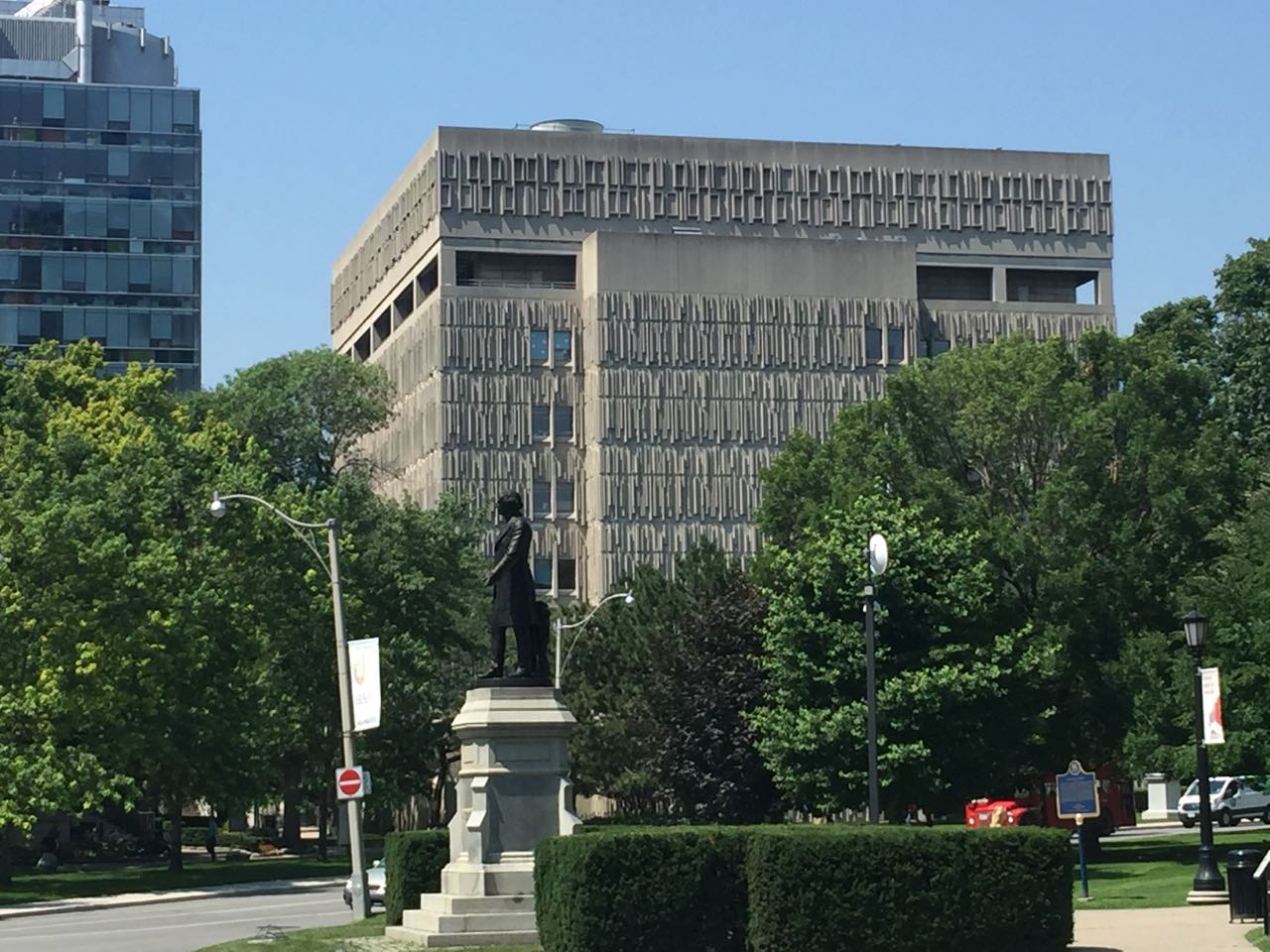
Mame Loshn Yiddish Exhibition at Robarts Library

IMG_3387 IMG_3389 IMG_3398 IMG_3395 IMG_3410 IMG_3422 IMG_3430 IMG_3436
<
>

Robarts Library

Robarts Library – Wikipedia

The John P. Robarts Research Library, commonly referred to as Robarts Library, is the main humanities and social sciences library of the University of Toronto Libraries and the largest individual library in the university. Opened in 1973 and named for John Robarts, the 17th Premier of Ontario, the library contains more than 4.5 million bookform items, 4.1 million microform items and 740,000 other items.

Source: en.wikipedia.org/wiki/Robarts_Library

University of Toronto – Wikipedia

University of Toronto – Wikipedia

Source: en.wikipedia.org/wiki/University_of_Toronto

Toronto Eaton Centre – Wikipedia

Toronto Eaton Centre – Wikipedia

The Toronto Eaton Centre (corporately styled as the CF Toronto Eaton Centre since September 2015)[2] is a shopping mall and office complex located in the downtown core of Toronto, Ontario, Canada. It is owned and managed by Cadillac Fairview (CF). It was named after the Eaton’s department store chain that once anchored it before the chain became defunct in the late 1990s.

Source: en.wikipedia.org/wiki/Toronto_Eaton_Centre

IAJGS Orlando

Orlando Jewish Info – Your Jewish Guide to Orlando

Orlando Jewish Info – Your Jewish Guide to Orlando

Orlando Jewish Info Guide

Source: www.orlandojewishinfo.com

Getting there

The Swan & Dolphin Resort at Disney World

Information Booths

The Big Shmooze

Down To Business

How Can We Help?

See Ya …..

…. in Warsaw

The Power Of Words

Here are some updates for you:

  • A new study guide for the Partisan Poem  is available. Mervyn Danker, school principal and Jill Rabinowitz,  English teacher, have combined to bring you an updated English study guide for the Partisan Poem by Hirsh Glik. This poem is the legacy of the partisans and survivors. It is now up to us to embrace it for future generations.  No other poem inspires hope as much as Zog Nit Keynmol!


  • We are progressing with our plan to recite the poem globally on International Holocaust Remembrance Day on 27 January 2018. Find your language here.


  • For more on how you can participate, watch the two inspiring videos on this page.

  • You can now follow all my posts in your own language. Simply click on “Translate” on the bottom right and select one of 104 flags to translate – even in Xhosa!
  •  Shana Tova & well over the Fast to all my Jewish friends.
    May you and your loved ones be inscribed in the Book of Life 
    for a happy, healthy, safe and prosperous New Year.
    Shana Tova and well over the Fast. 

    Ge’mar Chatima Tova. 
    Apples & Honey by Danielle Gild, Sydney


News From Vilnius

It began in the Vilna Ghetto in 1943.
As we approach the 75th anniversary of the anthem of the Survivors, we have established a program to recite the Partisan Poem, Zog Nit Kaynmol, in 23 languages around the globe.
Here is an article by Geoff Vasil which appeared overnight in the Lithuanian Jewish Community News

Don’t Give Up Hope: The Partisan Poem and Song Project

Hear it as a poem

The Poem

The Poem

The Partisan Poem It  was written as a poem of hope  by Hirsh Glik,  aged 20, in the Vilna ghetto in 1943. In English Aaron Kremer’s English version recited by Freydl Mrocki of Shalom Aleiche…

Source: elirab.me/poem/


Read Yuri Suhl’s 1953 essay 

SONG HEARD ROUND THE WORLD

By YURI SUHL 1953

Transferred by OCR from this book I sourced in the NYPL


Many songs came out of the ghettos and concentration camps of Europe during the last war. Most of these songs are of unknown authorship. They have about them the anonymity of the Pashaik-the striped prisoner’s garb-and the numbers tattooed on the victim’s arm. Singly, each depicts, both in concrete imagery and in general terms, either a particular phase of ghetto life, or the predominant mood of the ghetto dwellers at a given time. Together, they are the collective outcry of people subjected to an inhuman persecution. They form a record of martyrology and courage seldom met in human history.

These songs, though saturated with the pain and anguish that marked the life of the inhabitants of the ghetto, were nevertheless songs of hope and not of despair. The mood of resignation is absent from these songs. Their underlying theme is a deep yearning for a brighter day and an unswerving conviction that such a day will finally come and bring with it the destruction of Hitlerism and the liberation of Hitler’s victims.

With these songs on their lips the prisoners of the ghettos helped lighten the burden of their daily miseries, to face the gallows, firing squads and the torture chambers and the walk on the last path to the gas chambers. And with these songs on their lips, hushed by the rules of security, muted by the laws of secrecy, the underground met in dark bunkers to plot the strategy of the ghetto uprisings.

Some of these songs are still sung by ghetto survivors in various parts of the world; some form a part of artists’ repertories and are sung from the stage; others have become part of memories too painful to be stirred into consciousness. But one song, written in the ghetto of Vilna by a young poet named Hirsh Glik, has in the short space of a few years achieved a unique popularity. From being the official battle song of the Jewish partisans of the Vilna ghetto during the war, it has become, after the war, a hymn of Jewish people all over the world. Nachman Meisel, well-known Yiddish literary critic, writes in his booklet Hirsh Glik And His Song “Zog nisht kaynmol” [Never say]: “It is a significant and amazing phenomenon that without the sanction of any authoritative publication Zog nisht kaynmol was taken up spontaneously by all the sectors of the Jewish people as the highest and fullest expression of the sorrow and suffering, the protest and courage, that filled our hearts in the recent years of annihilation and rebirth.”

During my trip to Europe in 1948, I was able to observe at firsthand the extent of the popularity of this song and its power to move the Jews. My experience fully corroborates Mr. Meisel’s statement. I recall a spring morning in the town of Lignitz in Lower Silesia. As in every other town on my tour through Poland, several members of the local Jewish committee took me on a round of visits to Jewish institutions. We began our day with the Jewish children’s school, a large renovated building with spacious class rooms and modern facilities. The teachers had been informed beforehand of my scheduled visit. Upon my arrival, all classes were suspended and the students were assembled in a large auditorium. I greeted the several hundred pupils in behalf of the Jewish children of America and then read a story to them. In response they sang for me songs of the ghetto and of the new life in Poland. When the director announced that the visit with the American guest had come to a close, the children rose spontaneously to their feet and began to sing Zog nisht kaynmol.

I watched the expression on their faces, the look in their eyes. It was as though these young children had suddenly become mature and serious adults. They began singing slowly in a low but unfaltering tone. Gradually their voices rose, swelled to a high note and dropped again. It was not the music that controlled the volume of their voices, the even-measured cadence of their tones. It was the meaning of the words that determined their tonal emphasis. It was not just a song that they were singing. They were making a vow. They had sung this very song in the ghetto or had heard it from their fathers and mothers, who were no longer alive. Some remembered that it was with this song on their lips that partisan Jews had died fighting the nazis. For the children, the song was a firm resolve never again to be children of the ghetto. It was a song to honour the dead and to inspire courage in the living. Wherein lies the strength of this song? What single feature of its composition is the source of its popularity? Do its thoughts and sentiments express the essence of its vigour or does its form give this song its special quality? Is it the melody-strong, confident, hope giving and uplifting, yet permeated with an undertone of deep sorrow-that makes this song reach out to millions? Or do the circumstances out of which it was born endow the song with the touch of immortality?

HIRSH GLIK, RESISTANCE POET

Though each of these elements is worthy of separate treatment and serious consideration, it would be a grave error to ascribe the song’s vital message and overwhelming popularity to one single factor. Rather is it the aggregate of all these elements, combined to form one unified whole, that gives this song its quality. Any proper evaluation of it must begin with its origin and its author, Hirsh Glik.

Hirshke, as he was affectionately called, was born in Vilna in 1920. His father was a poor tradesman who eked out a precarious living. To supplement his father’s earnings, Hirshke was forced to seek a job at the age of 15. He worked as a clerk, first in a paper business and later in a hardware store. The sensitive youth was often seen going home from work late in the evening, his tired face showing the strain of long hours and hard work. The urge to write manifested itself early in Glik’s life, and his first literary products already revealed a vigour and freshness characteristic of a genuine poetic talent. He was a leading member of a young literary group of Vilna called “Yungvald,” which had published, under the editorship of the poet Leizer Wolf, several issues of a literary magazine bearing the name of the group. When the Germans occupied Vilna, and herded the Jews into a ghetto, Hirsh Glik, together with several hundred other Jews, was sent to Veisse Vake, a work camp 12 miles from Vilna. There they were set to digging peat. The working hours were long and living conditions in the camp extremely difficult. Although hard labor and inhuman treatment at the hands of the nazis robbed Glik of his physical energies, they failed to break his spirit. More than ever he was now possessed of a burning desire to record the miserable life of the work camp. Late at night, when his fellow prisoners lay exhausted on the floor of their hovels, Glik cried out both for them and himself the anguish of their souls in poetry. Many of these poems he had managed to transmit to the ghetto. He was twice awarded literary prizes for his poetry by the Jewish Writers and Artists Association of the Vilna ghetto. On several occasions he even managed to come to the ghetto himself. He would then spend most of his time in the Youth Club, reading his poetry to enthralled audiences.

In the early part of 1943, the Germans liquidated the work camp Veisse Vake and transferred all the Jews to the ghetto of Wilno. Those were not “ordinary” ghetto days. At dawn of April 5th, 4,000 Jews were put to death at Ponar. Those in the ghetto who had harboured the illusion that life in the ghetto had been “stabilised,” were suddenly shaken out of their complacency. A frantic search for weapons ensued. Then came a piece of news that electrified the ghetto. The underground radio operator picked up a brief bulletin: “The remainder of the Jews in the Warsaw ghetto have begun an armed uprising against the murderers of the Jewish people. The ghetto is in flames!”

Those flames, though geographically distant, set off sparks of revolt in other ghettos and filled the Jews with a deep sense of pride in their Warsaw brethren. They gave the call to arms. The search for weapons was more feverish than before. It was in those turbulent days under the direct impact of the uprising of the Warsaw Ghetto, that Hirsh Glik wrote his immortal Zog nisht kaynmol. And when the staff of the underground met to work out strategy and assign battle stations, the song was adopted as the official battle hymn of the partisans. But the people had preceded the underground staff in this choice. Long before the staff had accorded the song this singular honour, Zog nisht kaynmol was tremendously popular in the entire ghetto.

On the first of September 1943, when the Gestapo began the liquidation of the Wilno ghetto, the partisans barricaded themselves in various parts of the ghetto to battle the Germans. Hirsh Glik and his group were surrounded by the Gestapo before they could get to their weapons. They were taken prisoner and sent to the labor camp at Goldfield, in Estonia, where conditions were even worse than in previous camps. Even the privilege of possessing pencil and paper was denied to Glik. This, however, did not prevent him from continuing his creative work. He composed and recited by heart to his fellow prisoners.

One year later, in August 1944, the rapidly advancing Red Army forced the Germans out of their positions. The nazis began to liquidate the concentration camp in an effort to erase the traces of their fiendish work. Glik realised that liquidation of the labor camp spelled death for the Jews. Together with a group of fellow prisoners he escaped to the nearby woods. There he ran into a detachment of retreating Germans and was killed in the brief encounter. He died in the true spirit of his song, fighting the enemy of his people.

Zog nisht kaynmol has attributes of a folksong-simplicity of form, an easy, natural rhyme scheme, clarity of expression and unity of mood. Not a single word or line in it is incomprehensible to the least sophisticated person. It is unaffected to the point of artlessness. Yet it has a lyrical quality, and is permeated with a richness of imagery that places it in the category of a poem of high artistic caliber. It is indeed a rare combination of simplicity and art, blending harmoniously into a unified and heightened expression. But all these elements, however fine, would not suffice to give this poem the stature it has achieved. It is the mood of the song, so clearly and forcefully expressed, which is the core of this poem’s strength, vigour and durability. In this Zog nisht kaynmol Hirsh Glik has succeeded in articulating the prevailing mood and feelings of the Jews of the ghetto of Wilno and of resistance in all other ghettos and concentration camps. He had forged a fighting weapon.

The poet had adapted his words to an appropriate melody. The music was originally a Cossack Cavalry song composed by the Pokrass brothers, two Jewish Soviet composers, for a poem written by the Soviet poet A. Surkov.

Although words of the Cossack song are not related to the content of Glik’s poem, the music seems to blend harmoniously with the words of Zog nisht kaynmol. Without straining for symbolism, one cannot help but reflect on this association-a Soviet, Cavalry song wedded musically to a Jewish partisans’ battle poem. It is known that in areas liberated by the Red Army other Jewish partisans changed the fourth line of Glik’s song from “Svet a poyk tun undser trot; Mir zenen doh!” (Our marching steps will thunder: we are here) to: “Die Stalinshe chavayrim zenen doh!” (The comrades of Stalin are here).

Zog nisht kaynmol has been translated into many languages. We know about versions in Rumanian, Dutch, Polish (three versions), Spanish, Hebrew and English (five versions). Of the five English versions, that of the young Jewish American poet Aaron Kramer seems to me the most successful. “Niederland Film,” a Dutch film company, produced a documentary based on Glik’s song in 1947. And the famous Soviet Jewish poet, Peretz Markish, created an heroic character based on his conception of Hirsh Glik in his monumental Yiddish poetic work, War.

Thus a Yiddish song, inspired by the heroic uprising of the Warsaw Ghetto, written by a young Jewish partisan in the Wilno ghetto and adopted by the partisans of this ghetto as their offal battle hymn, has reached out to the far corners of the globe to become a battle song for peace for millions of people. For the message of this song, the warning it sounds, is as timely and vital for us today, when nazism is being restored in Western Germany became a battle song for peace for millions of people, as it was to the embattled Jews of the ghettos and the fighting Jews in the woods. In these days, when the architects of war pacts and the cold war use every device to sow gloom and despair in the hearts of the people, every expression of strength, courage and reaffirmation of faith in democracy is a rallying force. Hirsh Glik’s Zog nisht kaynmol is, in this sense, a weapon in the arsenal of democracy.


Please contact me for further details:

eli@elirab.com

Thanks

Eli

 

Back